Enterprise AI Security is a strategic framework of private infrastructure, encryption, and local inference protocols designed to protect proprietary data from external exposure. By deploying vLLM on Zadara Sovereign Cloud, organizations can run high-performance Large Language Models (LLMs) within a controlled, local environment that eliminates exposure to third-party data transmission. This approach ensures that sensitive business data and intelligence remains under complete organizational control, meeting the strict residency and privacy requirements of the modern digital landscape.
Beyond Chatbots: The Shift to Agentic AI
My previous GenAI blog explained how GenAI chatbots are transforming internal enterprise support by combining AI and automation with strong security and data control. While those RAG-powered systems revolutionized productivity, we are now moving into a more advanced paradigm: agentic AI frameworks.
Every time an employee uploads a document to a public AI platform like ChatGPT or Google Gemini, sensitive business data and intelligence is transferred to third-party servers. This is a documented fact reshaping how forward-thinking enterprises approach enterprise AI security.
Enterprise AI Security Trends and Market Reality
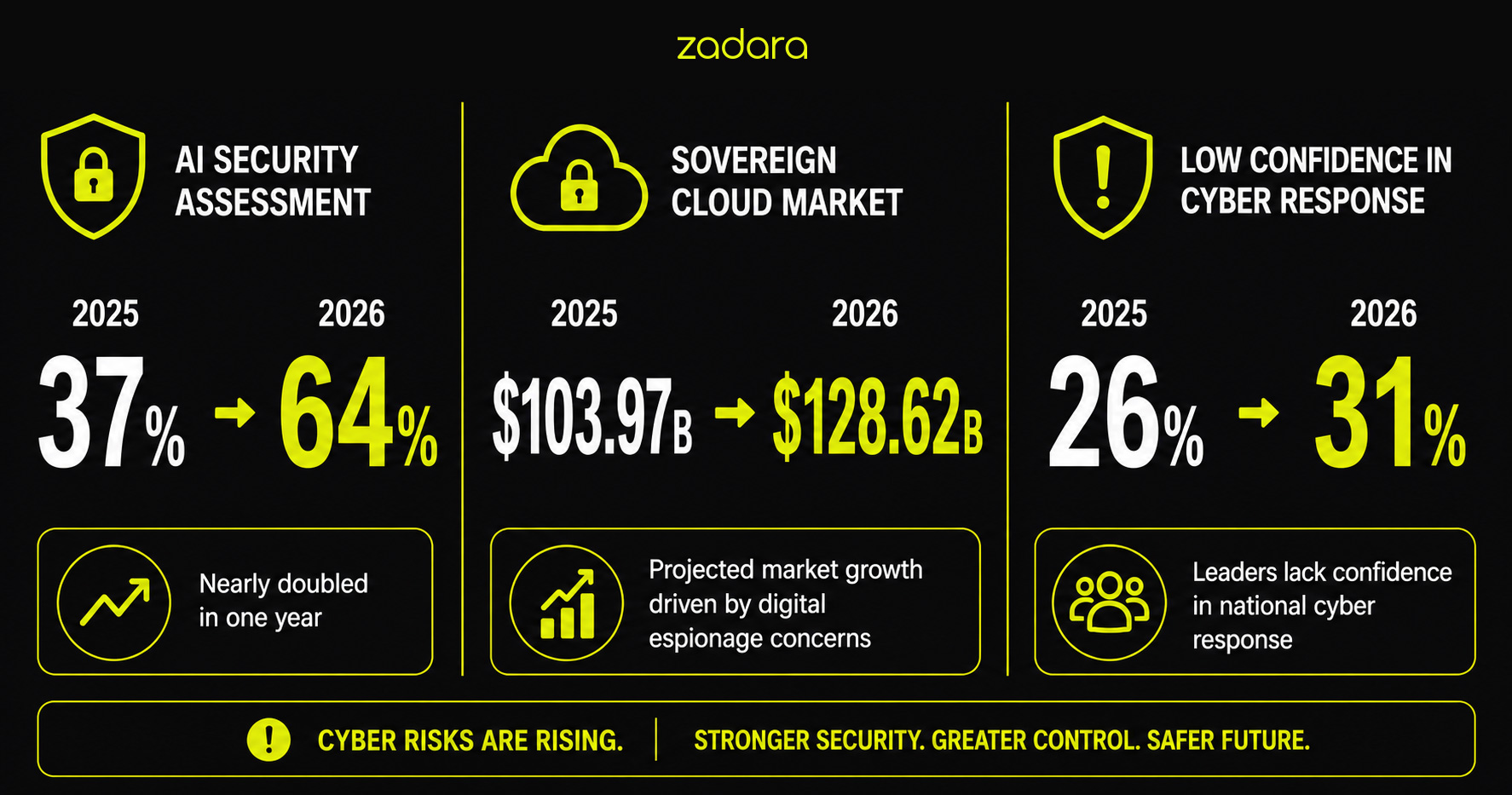
- According to the World Economic Forum (WEF) 2026 Global Cybersecurity Outlook, the percentage of organizations assessing the security of their AI tools has nearly doubled, rising from 37% in 2025 to 64% in 2026.
- According to Research and Markets, the global sovereign cloud market is projected to grow from $103.97 billion in 2025 to $128.62 billion in 2026, driven by rising digital espionage concerns.
- According to the WEF, 31% of leaders now report low confidence in their nation’s ability to respond to major cyber incidents, up from 26% last year.
“In the 2026 landscape… you are governing a non-human identity perimeter where autonomous agents outnumber human users by a ratio of 100-to-1.” — Thomas Nuth, Head of Product Marketing at Tenable.
Public vs. Sovereign AI: The Sortis Comparison
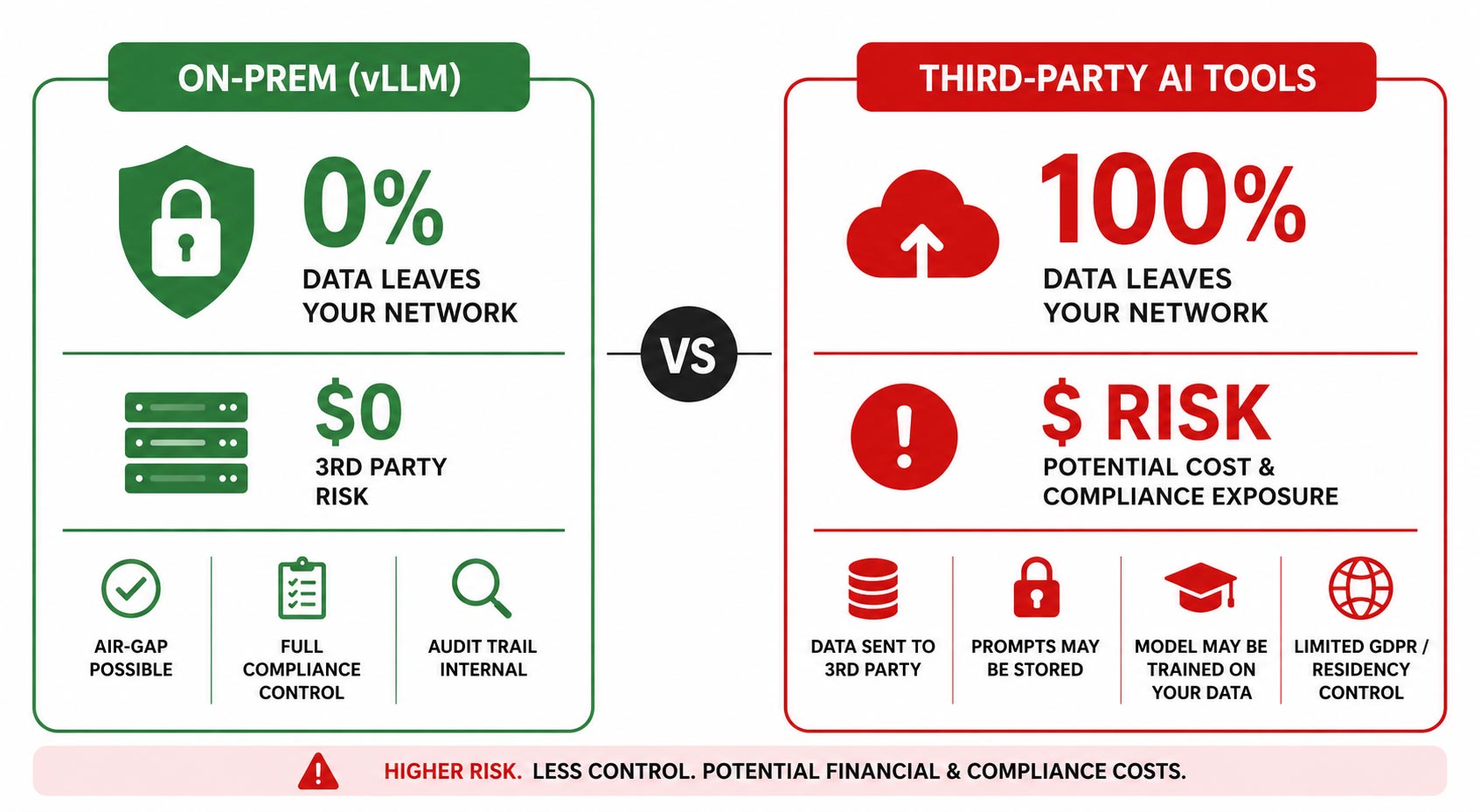
To understand how to secure AI, we must look at the data flow audit. The table below, provided by Sortis, https://www.sortis.es/, technical team (Zadara partner in Spain), illustrates why Internal vLLM running on Zadara sovereign infrastructure is the only architecture that prevents data from leaving your infrastructure.
| Criterion | vLLM (Internal) | NotebookLM | Gemini | ChatGPT | Claude | DeepSeek | Copilot |
|---|---|---|---|---|---|---|---|
| Data leaves org network | No — runs on-prem | Yes | Yes | Yes | Yes | Yes | Yes |
| Document sent to 3rd party | No | Yes | Yes | Yes | Yes | Yes | Yes |
| Prompts stored by vendor | No | Unknown | Unknown | Yes | Yes | Unknown | Yes |
| Model trained on your data | No risk | Risk | Risk | Risk | Risk | Risk | Risk |
| GDPR / residency control | Full | No | No | No | No | No | No |
| Air-gap deployment possible | Yes | No | No | No | No | No | No |
| Compliance audit trail | Internal | No | No | No | No | No | No |
| API key / auth dependency | No | Yes | Yes | Yes | Yes | Yes | Yes |
| Model version locked/auditable | Yes | No | No | No | No | No | No |
| Sensitive doc exposure risk | None | High | High | High | High | High | High |
Technical Showcase: Veltrix Veritas (Version 1 Architecture)
Veltrix Veritas is an AI-powered Document Intelligence Platform that transforms a single technical document (PDF, DOCX, PPTX, TXT) into structured sales intelligence. Built around a private vLLM inference server, all LLM calls stay on-premise and no data is sent to external commercial APIs. The Veltrix Veritas tool, exemplifies how enterprises achieve sophisticated AI capabilities without the “leakage” risks of public APIs. Built on a private vLLM inference server running on Zadara’s sovereign infrastructure, this Document Intelligence Platform ensures that:
- Inference stays local: Every prompt and document analysis occurs on-premise.
- Autonomous Search: Competitive intelligence is gathered via self-hosted SearXNG engines, keeping search queries private.
- Zero IP Contamination: Models run with fixed weights, ensuring your proprietary sales strategies never train a public model.
The Zadara Sovereign Cloud Advantage
Zadara Sovereign Cloud is fully aligned with the NVIDIA Software Reference Guide, bringing full-stack workload isolation and VM-based GPU tenancy to the sovereign cloud. This alignment confirms that Zadara implements key design principles such as network partitioning and per-tenant data volume separation.
Essential Controls for Enterprise AI Security
- Data Sovereignty: Metadata and logs never cross geopolitical borders.
- Operational Autonomy: Organizations avoid the “export controls” or outages of hyperscale providers.
- Financial Predictability: A 100% OpEx pricing model with zero hidden transport fees ensures AI projects remain budget-stable while scaling.
Enterprise AI Security: Securing Your Competitive Advantage
The shift toward sovereign AI infrastructure isn’t just a security update; it’s a strategic necessity. As cyber-enabled fraud becomes a top concern in 2026 and AI is no longer optional, the ability to control your AI supply chain is the ultimate requirement for business resilience. With Zadara Sovereign Cloud, you can harness the power of AI without sacrificing the security of your most valuable asset: your data.
Naga, Sortis – co-author.
Naga Venkata Satya Sai Krishna Munukutla is an AI Product Lead at Sortis, where he defines and executes the AI vertical’s short- and long-term roadmap building internal and external AI use cases in collaboration with Zadara Cloud Solutions. He brings 10 years of technology experience: four years in AI product development, and six years in IoT and data analytics. His current focus is sovereign AI infrastructure and AI-powered products including the Veltrix Veritas, On-premise training of an AI model, and AI applied in telecommunication sectors.