Broadcom’s acquisition of VMware did more than just disrupt a tech ecosystem; it forced enterprise IT leaders to re-evaluate the true cost of their infrastructure. With renewal costs skyrocketing up to 1,200% for some customers, the traditional, VMware-centric approach to disaster recovery has transitioned from a stable insurance policy to an unsustainable financial risk.
However, looking beyond the immediate sticker shock reveals a massive opportunity. The explosive rise of the Disaster Recovery as a Service (DRaaS) market, set to triple over the next decade proves that the future of business continuity is cloud-native, agile, and vendor-agnostic. Upgrading your DR strategy isn’t just about escaping a punishing licensing model; it’s about modernizing your resilience for the next decade.
The VMware Disaster Recovery Crisis: Why Heterogeneous Solutions Are the Answer
The enterprise IT landscape has fundamentally shifted since Broadcom’s acquisition of VMware. Organizations implementing VMware in their primary site and VMware disaster recovery face unprecedented challenges that extend far beyond simple price increases. What started as a technology investment strategy has evolved into a critical business continuity crisis affecting companies of every size.
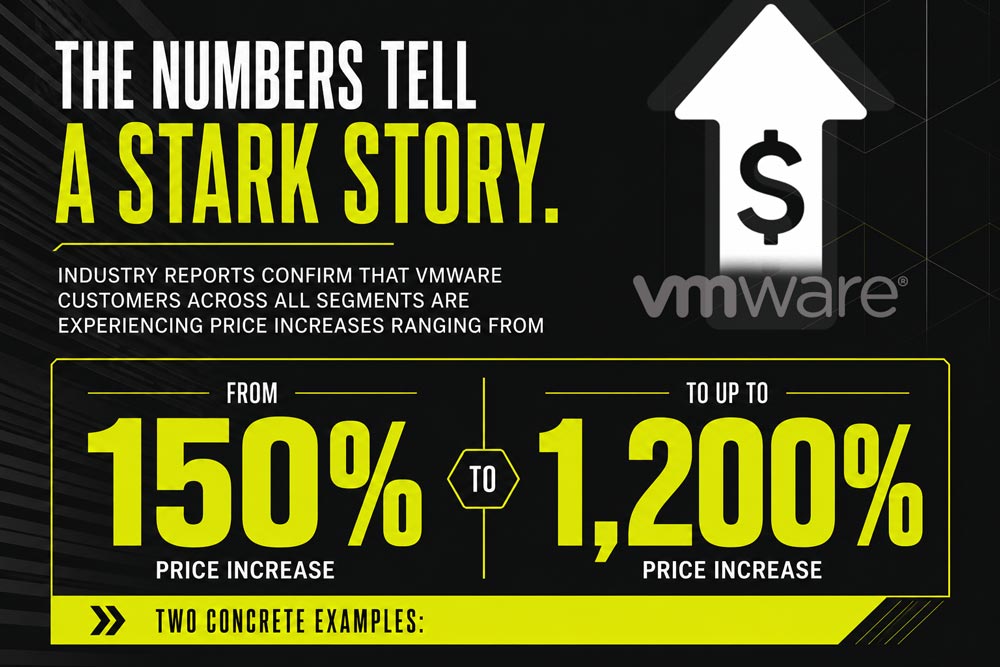
The numbers tell a stark story. Industry reports confirm that VMware customers across all segments are experiencing price increases ranging from 150% to up to 1,200%. Here are two concrete examples:
- Mid-Sized Financial Services Organization: A company with 200 virtual machines recently saw their annual VMware costs jump from $180,000 to $720,000 under the new licensing model.
- Large Manufacturing Enterprise: An organization with 2,000 VMs faced an increase from $1.8 million to $8.2 million annually.
These aren’t isolated incidents. They represent a systematic shift that affects organizations regardless of their infrastructure size. For IT decision-makers seeking broader VMware alternatives, there are numerous platforms like Nutanix, Proxmox, and other virtualization solutions.
However, these general replacement strategies don’t address a critical reality: many organizations cannot immediately replace VMware in their production environments due to legacy application dependencies, strict compliance requirements, or operational constraints.
Beyond Traditional VMware Disaster Recovery: The Double Burden Challenge
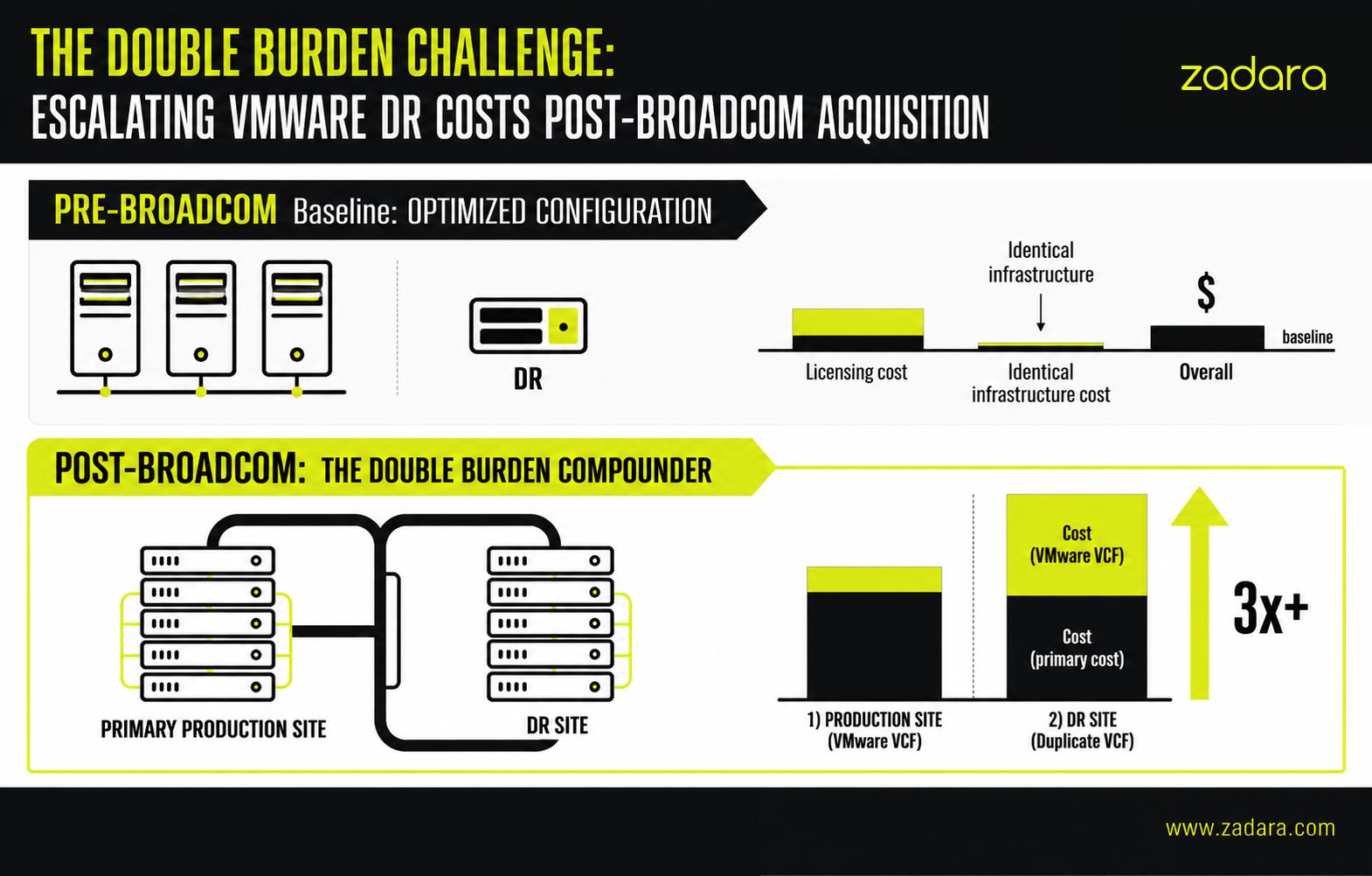
This operational gridlock creates what industry experts call the “double burden problem.” Organizations face escalating VMware costs not just in their production sites, but also across their VMware DR sites. Traditional VMware disaster recovery approaches require significant, identical capital investments for both production and DR sites due to the new licensing models.
For many organizations, this represents an unsustainable budget impact that demands immediate action.
The Heterogeneous DR Advantage: Breaking the Vendor Lock-in Cycle
Most legacy vendors in the business continuity space promote homogeneous architectures, either VMware-to-VMware solutions or alternative-to-alternative solutions. This approach doesn’t align with real-world operational realities.
Heterogeneous disaster recovery solutions provide the flexibility needed to adapt to existing infrastructure and actual operational needs. By decoupling the DR layer from the primary hypervisor, organizations can maintain their current production VMware environment while establishing a cost-effective, alternative-platform DR site. This hybrid approach directly addresses immediate financial pressures while simultaneously providing a safe, de-risked pathway for gradual migration.
The flexibility of heterogeneous configurations allows organizations to optimize their data protection strategy based on current financial realities rather than ideal vendor scenarios. Companies can safely validate alternative platforms within their isolated DR environment, build necessary operational expertise among their engineering staff, and plan strategic long-term migrations, all without the risk of disrupting critical, day-to-day production workloads.
Zadara’s Unique IaaS Positioning for Heterogeneous VMware Disaster Recovery
While most infrastructure providers focus on selling rigid, homogeneous solutions, Zadara’s Infrastructure as a Service (IaaS) platform is uniquely positioned to solve the heterogeneous DR challenge. The key differentiator lies not in the DR software itself, but in Zadara’s fundamentally different approach to infrastructure delivery and enterprise management.
- Edge-Native Global Architecture: Zadara’s edge-native cloud architecture provides over 500 global locations, enabling organizations to establish geographically distributed DR sites without the heavy capital expenditure (CapEx) requirements of setting up a complete cloud for secondary infrastructure. This advantage is critical when implementing a modern VMware disaster recovery solution, allowing organizations to select optimal DR locations based on latency, digital sovereignty, compliance, and regional cost considerations without significant CapEx investment.
- Pay-As-You-Go Economics: Zadara’s utility-billed IaaS model eliminates the upfront capital expenditure burden that makes traditional secondary DR sites financially prohibitive under VMware’s new per-core licensing structures. Organizations pay only for the exact compute and storage resources they consume, entirely avoiding the upfront infrastructure investments and ongoing passive licensing costs that create the double-burden problem. This economic model enables immediate DR implementation without budget approval delays or capital allocation challenges.
- Vendor-Agnostic Ecosystem: The platform’s open design extends beyond simple infrastructure provisioning. Zadara seamlessly integrates with leading enterprise replication software providers like CirrusData Solutions and RackWare. This enables organizations to select the absolute optimal tool for their specific hypervisor transformation requirements rather than being constrained to a single solution.
Advanced VMware Hypervisor Recovery with Heterogeneous Architecture
Modern VMware hypervisor recovery requires platform-agnostic approaches that work seamlessly across diverse, multi-cloud environments. Zadara’s ecosystem partnerships enable sophisticated, automated DR algorithms that address specific organizational recovery point goals while maintaining the core flexibility required for heterogeneous configurations.
CirrusData Solutions Integration: Instant Mobility
For environments requiring continuous data protection, integration with CirrusData Solutions provides near-instant recovery capabilities. Organizations can achieve Recovery Point Objectives (RPO) of just 10-15 minutes, with Recovery Time Objectives (RTO) constrained only by available network bandwidth. This enterprise performance tier positions heterogeneous solutions as competitive alternatives to traditional VMware-only approaches, eliminating the performance and data-loss concerns that historically drove homogeneous architecture decisions.
For more details, please visit: https://www.youtube.com/watch?app=desktop&v=QfuUH94g1nI&ra=m
RackWare Management Module: Intelligent “Store-and-Forward”
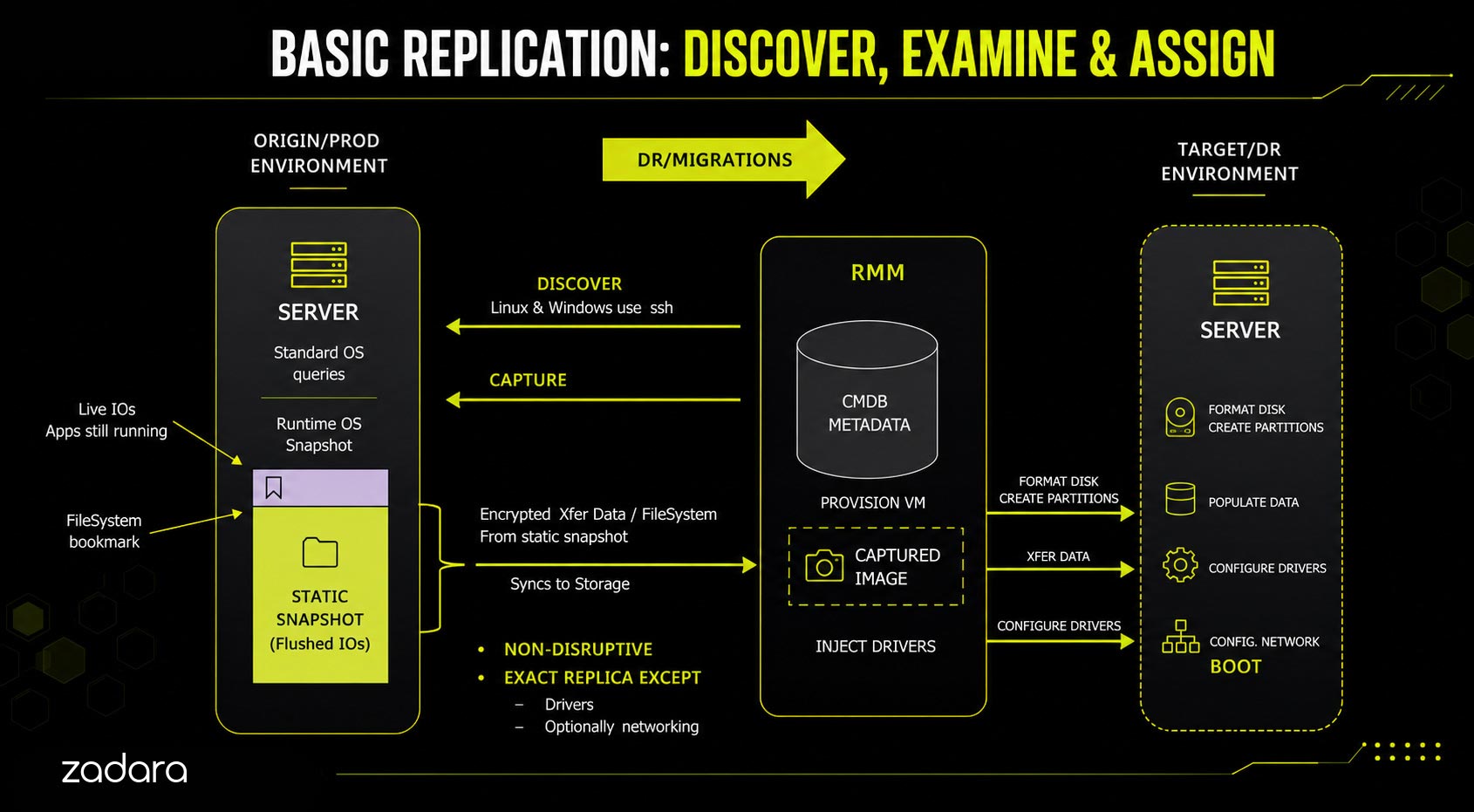
For broad enterprise application landscapes, RackWare’s Management Module offers a highly flexible “store-and-forward” replication model. Instead of relying on hypervisor-level replication locks, the solution automatically queries source operating systems to perfectly size target virtual machines on the fly.
It leverages Logical Volume Manager (LVM) snapshots for Linux and Volume Shadow Copy Service (VSS) for Windows to capture exact, application-consistent system states. This decoupled approach ensures highly accurate replication and flawless bootability regardless of the underlying platform differences between the production site and the Zadara DR site.
Granular Policy Management
Advanced policy-driven management capabilities enable IT organizations to optimize resource allocation based on strict business priorities:
- Tier-1 Applications: Critical production servers can be synchronized on continuous, aggressive schedules.
- Development & Testing Workloads: These workloads can be replicated less frequently to save bandwidth.
- Dynamic Provisioning: Selected compute targets can utilize dynamic provisioning. In other words, the target VMs are built and turned on only during an actual failover event, minimizing idle compute costs to near zero.
This granular level of control is exceptionally valuable in heterogeneous environments, where resource optimization across disparate platforms directly yields a lower total cost of ownership.
Implementation Strategy: The Bridge to VMware Independence
The ideal DR solution for VMware environments must balance immediate cost relief with long-term strategic agility. Zadara’s heterogeneous approach provides a highly reliable “bridge strategy” that addresses current financial emergencies while quietly enabling gradual migration planning.
- Streamlined Environment Assessment: Organizations begin with a thorough assessment of their current VMware footprint and disaster recovery interdependencies. While industry research shows that only 5% of organizations complete initial vendor risk assessments in under a week, Zadara’s streamlined evaluation process bypasses traditional procurement bottlenecks to enable rapid decision-making.
- Non-Disruptive Testing: The non-disruptive testing capabilities engineered into Zadara’s ecosystem partners allow for full validation of heterogeneous DR procedures without impacting live production workloads or triggering false alerts.
- Phased Onboarding & Realized Savings: Implementation typically starts with non-critical workloads to validate the heterogeneous framework within the organization’s specific network topology. As operational confidence matures, teams expand protection to mission-critical applications. This phased approach minimizes operational risk while yielding immediate financial dividends: organizations report cost reductions of 40% to 70% for their DR infrastructure when migrating from homogeneous VMware setups to Zadara’s heterogeneous approach.
Real-World Implementation: A Financial Services Provider Success Story
This success story provides a concrete example of successful DR implementation on Zadara IaaS. The organization required protection from natural disasters and cyber attacks for their production cloud in Manila, Philippines. They needed a solution that didn’t require owning or managing hardware while providing lower costs than build-your-own alternatives.
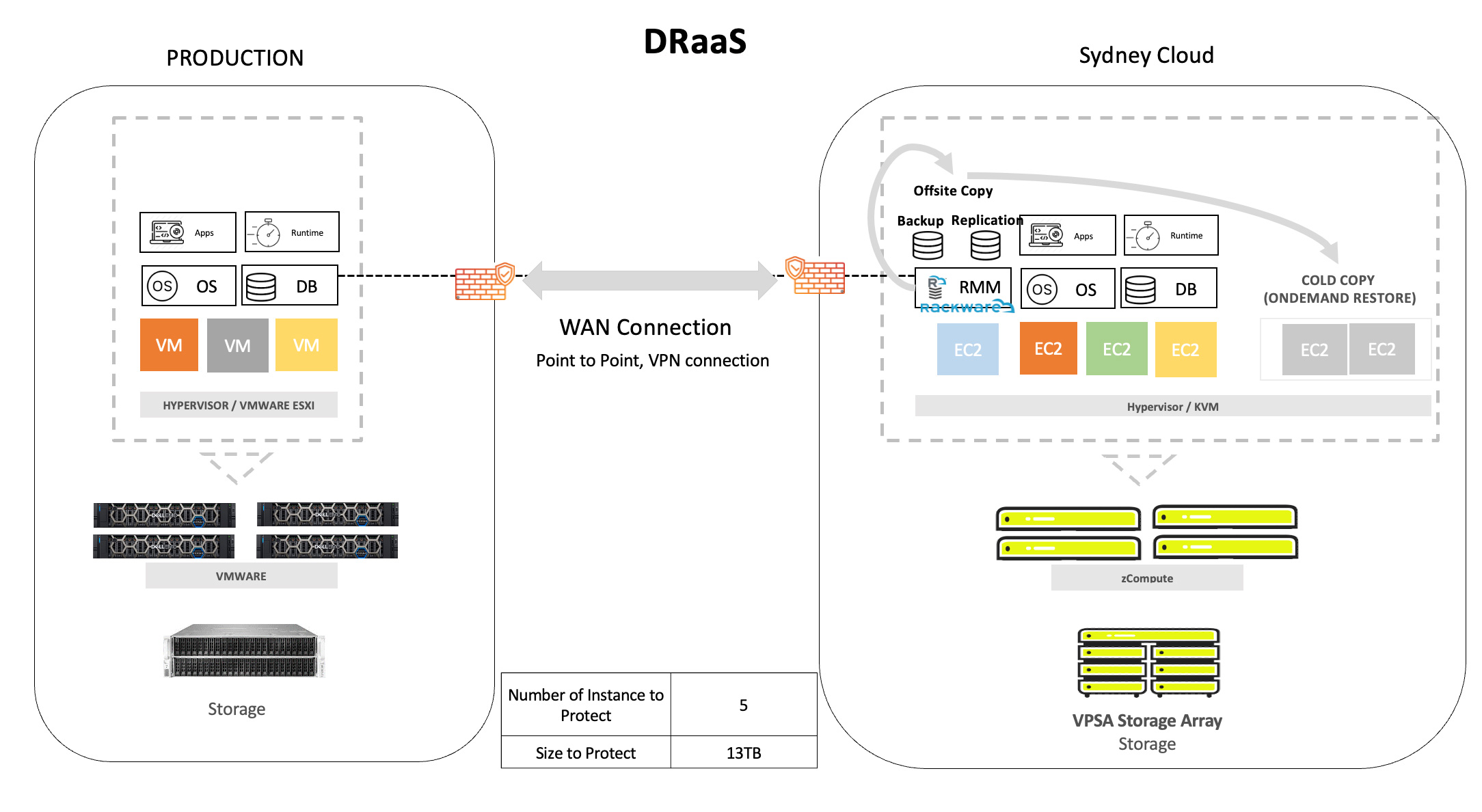
The implementation protected 6 VMs running critical business applications, including LAMP stack production environments, LAMP UAT for testing and validation, and SAP workloads supporting financial and operational processes. The solution used RackWare technology to replicate to a remote site in Sydney, providing geographic separation and protection against regional disasters.
The result was a drastically lower-cost solution than traditional “Build-Your-Own” approaches without the operational burden of managing hardware and infrastructure. This case demonstrates how organizations can maintain business continuity while reducing both capital and operational expenses.
The Strategic Imperative: Act Before Your Next Renewal
The convergence of VMware’s licensing crisis with the growing availability of stable, heterogeneous DR solutions creates a historic opportunity for organizations to escape vendor lock-in while significantly improving their disaster recovery capabilities. With 86% of organizations actively looking to reduce their VMware footprint, early adoption of heterogeneous DR architectures provides an immediate competitive advantage through reduced fixed overhead and increased operational agility.
Zadara’s combination of enterprise-grade control and cloud-native agility positions the platform as the ideal destination for organizations seeking to maintain strict data governance while escaping punitive licensing constraints. The global data center network ensures geographic resilience, while the utility pricing model permanently eliminates the unpredictability of vendor-driven cost increases.
The question for IT decision-makers is no longer whether to evaluate heterogeneous alternatives, it’s how quickly you can execute a strategy that provides immediate budget relief while building the foundation for long-term cloud independence. The time for action is now, before your next VMware renewal cycle locks your enterprise into years of escalating costs.
Ready to explore how Zadara’s heterogeneous DR approach can solve your VMware licensing challenges while improving disaster recovery capabilities? Contact our team today for a customized assessment of your current environment and a transparent cost analysis that shows exactly how much you can save with a heterogeneous architecture.