The enterprise virtualization landscape has been turned upside down. For more than two decades, VMware dominated as the undisputed leader, but Broadcom’s $69 billion acquisition has fundamentally altered the game. The search for viable VMware alternatives has intensified following Broadcom’s acquisition, with over 70% of enterprises actively exploring mitigation strategies to cope with dramatic cost increases.
The numbers tell a stark story. Customers are reporting 8x to 15x cost increases on renewal, with some organizations facing 100% to 800% price increases across VMware’s customer base. Broadcom eliminated perpetual licenses, moved to subscription-only pricing, and switched to per-core licensing with a minimum 72-core requirement—a 350% increase from the previous 16-core minimum.
Every CIO and CTO we speak with has the same reaction: “We need to get off VMware”. What was once a technology preference has become a critical risk mitigation strategy. But here’s the problem—most enterprises evaluating VMware alternatives make two critical strategic mistakes that waste time, money, and resources while failing to solve the underlying issues.
The Two Wrong IT Survival Strategies
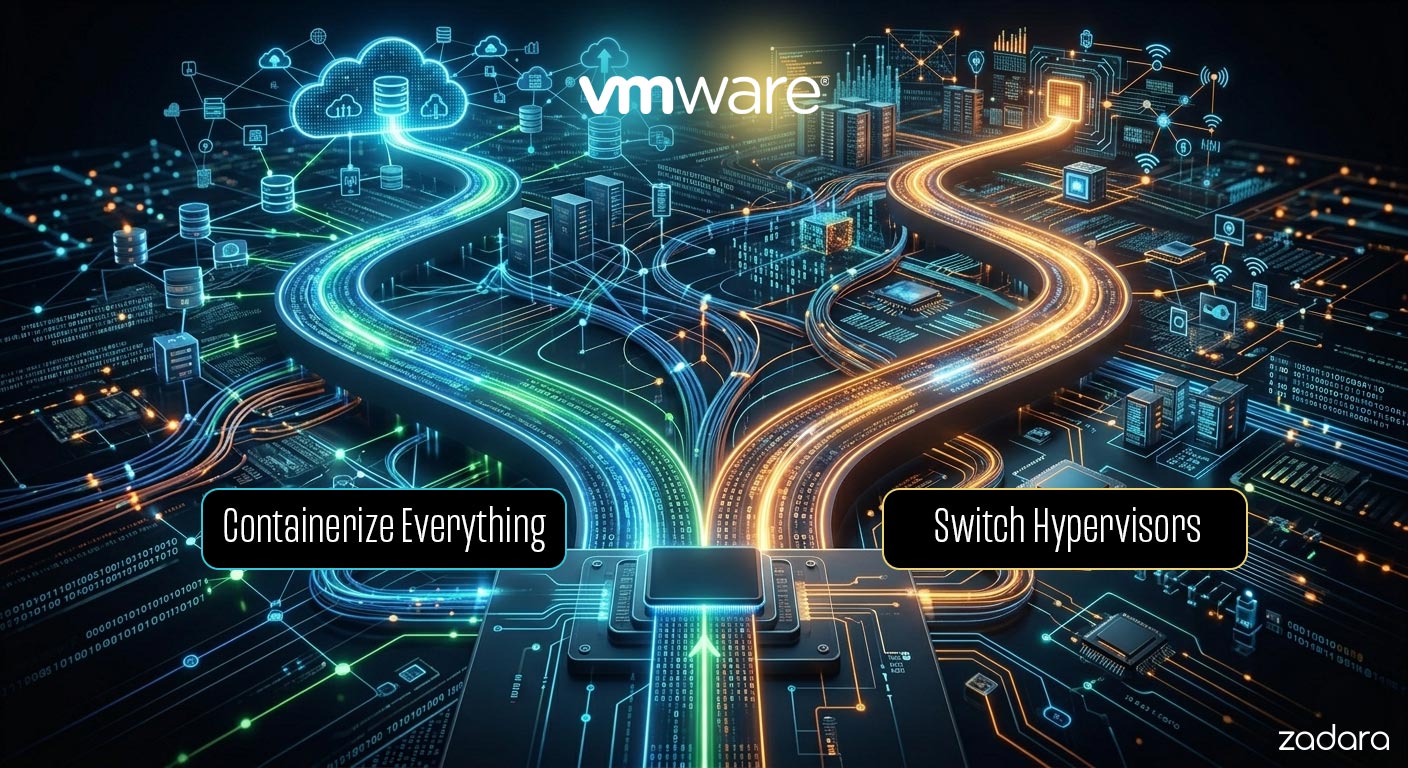
Strategy #1: “Containerize Everything”
The first misguided approach involves hiring teams of consultants to rewrite 15-year-old Windows workloads as microservices. Organizations embark on ambitious containerization projects, believing they can modernize their way out of the VMware problem.
The reality is harsh. 18 months later, they’ve burned $2 million, migrated only 12% of their estate, and their SCADA system still runs on ESXi. Legacy applications resist containerization, business-critical systems can’t afford downtime during rewrites, and the complexity of managing both old and new architectures creates operational nightmares.
This approach fails because it treats a licensing and cost problem as a technology modernization challenge. While containerization has its place in modern IT strategies, using it as an escape route from VMware licensing costs is like using a sledgehammer to fix a watch—expensive, time-consuming, and likely to break more things than it fixes.
Strategy #2: “Switch Hypervisors”
The second common mistake involves moving from VMware to alternatives like Proxmox or Hyper-V. Organizations think they’re solving the problem by escaping one licensing model, but they simply enter another. The architecture remains fundamentally the same—they still manage VMs in one system and containers in another, maintaining two panes of glass, two operational models, and two sets of required skills.
→ Check out my previous blog about the top six alternatives: Zadara, Microsoft Hyper-V, Citrix Hypervisor, Red Hat Virtualization, Nutanix AHV and Ace Cloud.
Traditional VMware competitors focus on hypervisor replacement rather than infrastructure transformation. This approach represents a tactical fix rather than a strategic solution. The complexity tax just changes vendors, and organizations often discover that switching hypervisors introduces new challenges around management tools, staff training, and integration complexity.
Evaluating VMware Alternatives: The Strategic Landscape
The market disruption has prompted a surge in innovation among VMware alternatives. However, most alternatives to VMware focus on feature parity rather than addressing the fundamental problems that made VMware expensive and complex in the first place.
Here’s what nobody wants to hear: the problem was never virtualization itself. It was the proprietary management stack sitting on top of it—ESXi, vCenter, the per-core licensing, and the forced bundling. That’s the tax, not the hypervisor itself.
→ More details can be found here.
Broadcom’s consolidation from 168 product bundles to just 4 has further limited flexibility, forcing customers to purchase higher-tier bundles that include features they don’t intend to use.
The licensing changes have disrupted VMware’s partner ecosystem as well. The elimination of the White Label program has effectively excluded numerous service providers from the VMware ecosystem, reducing competitive pressure and potentially leading to further cost increases.
Why Most VMware Alternatives Miss the Mark
Most VMware ESXi alternatives still require separate management stacks and licensing models. Organizations escape VMware’s licensing complexity only to encounter new forms of vendor lock-in, management overhead, and operational complexity. They’re essentially rearranging deck chairs on the Titanic, changing the vendor but not the fundamental infrastructure ownership model that creates these problems.
The real issue isn’t finding a different hypervisor; it’s questioning whether you want to continue owning infrastructure at all. The most effective alternatives to VMware don’t just replace technology—they replace the economic model entirely.
VMware Alternatives Enterprise: The Zadara Advantage
Zadara represents a new category of VMware alternatives that addresses root infrastructure challenges rather than simply offering hypervisor replacement. Instead of replacing one hypervisor with another, Zadara replaces the entire infrastructure ownership model with a consumption-based cloud platform that delivers a “hyperscaler-like cloud experience on-premises.”
The Consumption-Based Revolution
Zadara eliminates both hardware purchases (CapEx) and software license fees, converting them into a single monthly service (OpEx) to maximize financial efficiency. This consumption-based alternative to VMware provides up to 30% lower total cost of ownership compared to Azure and an average 25% reduction in first-year cloud expenses.
Unlike traditional VMware competitors, Zadara eliminates the entire ownership model. Organizations no longer need to worry about hardware refresh cycles, software licensing audits, or capacity planning. The platform provides predictable costs without hidden fees or unexpected charges—a stark contrast to the subscription complexity Broadcom has introduced.
Enterprise-Grade Security and Compliance
Enterprise-grade VMware alternatives enterprise solutions must provide predictable costs and performance while maintaining security standards.
Zadara’s platform includes strong encryption for data at rest and in transit, role-based access control for granular permission management, and compliance support for regulations like GDPR and HIPAA.
Finding the Right VMware Alternatives: DCIG Recognition
Zadara’s VMware alternatives enterprise platform delivers DCIG Top 5 recognition across multiple market segments. The company has been named a DCIG Top 5 VMware Alternative in both the 2026-27 SLED (State, Local, and Education) Edition and SME (Small and Medium Enterprise) Edition.
→ Read the Reports: SLED and SME
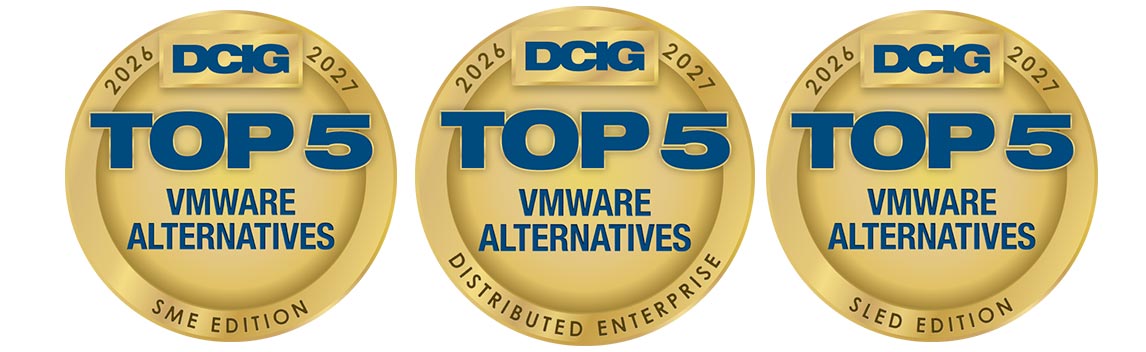
This recognition from DCIG, an independent research firm that provides authoritative analysis of enterprise IT solutions, validates Zadara’s position as a viable alternative for organizations seeking to escape the cost pressures and complexity introduced by Broadcom’s VMware changes.
The ideal alternative to VMware should address both technical and financial challenges. Zadara’s recognition spans multiple editions of DCIG’s reports, indicating broad applicability across different market segments and organization sizes—from small businesses to large enterprises and government organizations.
Beyond VMware ESXi Alternatives: A New Approach
Zadara transcends traditional VMware ESXi alternatives by replacing the entire infrastructure paradigm. Rather than asking which hypervisor to choose next, organizations should ask whether they want to continue owning infrastructure at all.
The platform delivers true multi-tenancy for sovereign AI, compute, and data services. Tenant instances are isolated by design, guaranteeing performance, security, and redundancy while customers scale from small beginnings to large deployments. This approach eliminates the complexity of managing separate systems for VMs and containers, providing a unified platform that grows with organizational needs.
Zadara provides detailed migration guidance for organizations transitioning from other platforms, including step-by-step approaches for exporting VMs from existing platforms, converting disk formats, importing into Zadara’s zCompute platform, and minimizing downtime during transition. This migration support reduces the perceived risk and complexity of switching from VMware.
The Strategic Choice: Ownership vs. Consumption
The post-Broadcom era has created an inflection point where organizations must fundamentally reconsider their infrastructure strategies. The question isn’t which VMware alternatives offer the best feature parity, it’s whether the traditional infrastructure ownership model still makes sense in an era of cloud economics and consumption-based services.
Zadara’s SLA guarantee policy proves enterprise-grade stability, making it a compelling VMware replacement for organizations seeking predictable costs and operational simplicity. The platform enables enterprises to replace VMware with a fully managed, consumption-based cloud platform without rewriting existing applications, addressing the core challenge that makes both containerization and hypervisor switching strategies fail.
Organizations evaluating VMware exit strategies should focus on solutions that eliminate the root causes of complexity and cost escalation rather than simply replacing one set of challenges with another. The most successful transitions will be those that embrace new economic models rather than perpetuating old ownership paradigms with different vendors.
The post-Broadcom era demands strategic thinking, not tactical fixes. Zadara offers that strategic alternative—a consumption-based platform that eliminates the licensing complexity, hardware ownership burden, and operational overhead that made VMware expensive long before Broadcom’s acquisition accelerated the exodus.
Ready to explore a true alternative to traditional infrastructure ownership? Learn how Zadara’s consumption-based cloud platform can eliminate your VMware licensing challenges while providing enterprise-grade performance and predictable costs.