The cloud landscape is evolving rapidly, and many organizations are building a new cloud migration strategy because their AWS infrastructure no longer meets their evolving needs. Rising AWS costs, complex licensing restrictions, and unpredictable data egress fees along with the rise in the need for digital sovereignty, AI services and particularly sovereign AI services are driving organizations to seek alternatives that offer better control, predictable pricing, and superior performance.
Managed Service Providers (MSPs) and cloud partners are under pressure to deliver modern cloud services securely while protecting margins. As customer data grows, AWS egress fees quietly eat into profitability and create billing friction. Egress fees have risen up to 6-15% of customers’ cloud bills (depending on the use-case).
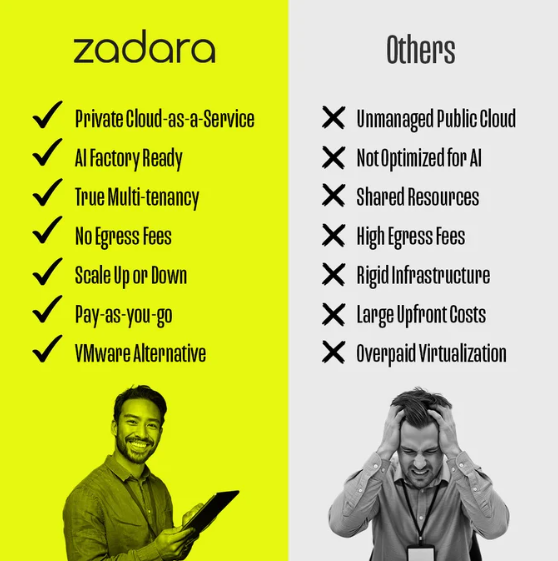
With Zadara, you can offer a sovereign cloud service with zero egress fees, simple usage-based economics, and global availability you can deploy fast in your customers’ preferred locations, including on-premises and edge sites. Additionally, Zadara service is optimized for modern AI training and inference use cases.

Planning an AWS to Zadara Sovereign Cloud migration requires careful consideration of your current infrastructure and business requirements. Any migration journey out of AWS should start with detailed assessment of your AWS environment and solid design of all the migration steps. This migration represents more than just a platform change—it’s an opportunity to gain hyperscaler-like capabilities while maintaining private cloud control. Organizations choosing Zadara benefit from multitenancy and predictable pricing structures that eliminate the cost volatility often experienced with traditional cloud providers.
The AWS to Zadara Sovereign Cloud migration process can be completed using 3 proven methods, each designed to address different technical requirements and business constraints. Many organizations have successfully completed their AWS to Zadara Sovereign Cloud migration with significant cost savings, with some reporting operational expense reductions of 30-40%.
Why Choose Zadara Over Traditional Cloud Providers
Zadara delivers hyperscaler-like behavior without the associated complexity of traditional cloud providers. Unlike AWS, which can lock organizations into proprietary technologies and unpredictable pricing models, Zadara provides a complete cloud experience that eliminates upfront hardware investments while offering transparent, consumption-based pricing.
The platform’s architecture addresses key pain points that drive organizations away from AWS. Where AWS creates vendor lock-in through proprietary licensing and complex data transfer fees, Zadara offers flexibility and freedom. Organizations can start with a small half-rack footprint and scale to over 100 nodes with Large Cluster Support (LCS) architecture, paying only for resources they actually use. They can also use cloud services provided by Zadara Partners who can offer the same benefits plus provide additional Managed Services.
Zadara’s multitenancy architecture makes it ideal for managed service providers and large enterprises requiring secure, efficient resource allocation. This approach contrasts sharply with AWS’s shared infrastructure model, where performance can be unpredictable and security boundaries less defined. The user-friendly environment simplifies resource management, allowing IT teams to focus on core operations rather than wrestling with complex cloud administration tasks.
A Proven Cloud Migration Strategy: AWS to Zadara Methods
Method 1: Manual Export and Rebuild for Your Cloud Migration Strategy
The manual export and rebuild approach involves documenting your entire AWS environment, including VPCs, subnets, security groups, public IPs, and NAT Gateways, then recreating these components on Zadara’s zCompute platform. While this method requires significant planning and documentation, it provides complete control over the migration process.
This approach works best for organizations with well-documented infrastructure and dedicated migration engineers. The process allows for optimization during migration, as teams can redesign architectures to take advantage of Zadara’s unique capabilities. However, organizations should be aware that AWS might block export avenues for licensed operating systems like Windows Server or RHEL.
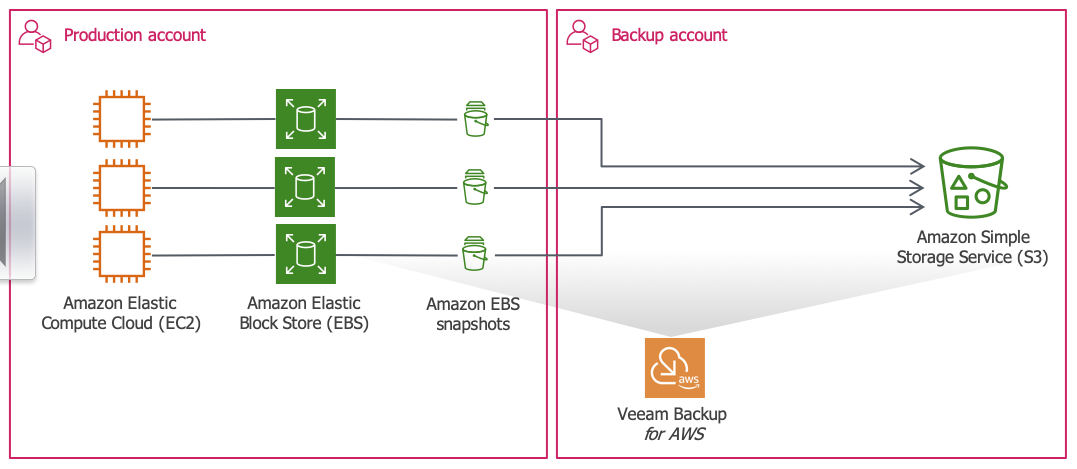
Method 2: Veeam Backup and Restore
Organizations already using Veeam for backup and Disaster Recovery can leverage their existing investment for migration. This method involves using Veeam backup and restore capabilities to move workloads from AWS to Zadara’s zCompute platform.
While this approach involves installation agents, downtime and additional costs, it provides a familiar process for IT teams already comfortable with Veeam. The method works particularly well for organizations with scheduled maintenance windows and applications that can tolerate downtime during migration.
Method 3: Migration Partners
For organizations seeking the best control over migration with minimal downtime, third-party any-to-any migration tools offer the most flexibility. Ecosystem includes leading solutions, such as RackWare, CloudAny and CirrusData Solutions, each providing specialized capabilities for different migration scenarios. Migration service provider partners, such as BBT in Japan, can lead the migration process using the above third-party tools.
These tools excel at handling complex migrations involving multiple workloads, databases, and applications. They can often work around AWS’s export restrictions and provide real-time synchronization capabilities that minimize downtime. The investment in these tools typically pays for itself through reduced migration time and lower risk of data loss or extended outages.
Comment
Please note that methods 2 and 3 require method #1 to be implemented too: VM migration by itself doesn’t provide the VM’s runtime environment, such as: VPCs, subnets, GSs, LBaaS, EIPs and NATGW.
Important Windows Server Considerations for Your Cloud Migration Strategy
Organizations running Windows Server workloads must address licensing requirements post-migration from AWS to zCompute.
For VMs running Windows Server Standard Edition, teams must remove the old product key and reactivate Windows with a new activation key. This new key can be either a Zadara key or an MSP key, depending on whether you’re using Zadara Public Cloud, an MSP operated cloud or OPaaS.
Windows VMs check for Microsoft KMS license activation server (hosted at AWS) every random interval, and if these servers aren’t found, the VM will deactivate its license. The design of the windows license activation system by Microsoft is that it must contact the KMS license server for initial activation, and it checks at random intervals afterwards to re-certify the license. The idea is that if the VM leaves AWS hosting space and the VM can’t reach the AWS KMS license server anymore, the windows license will expire.
Using AWS services until the migration to Zadara is fully completed
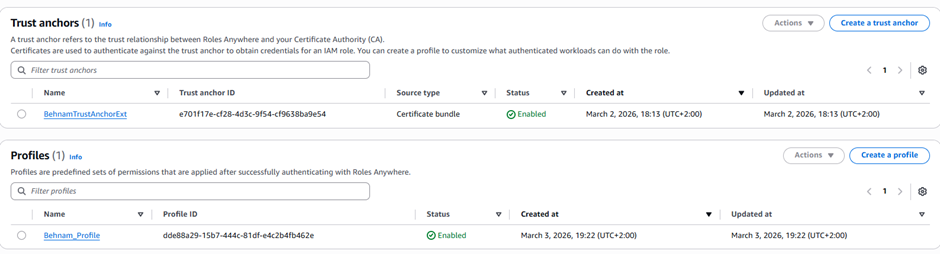
Organizations that want to keep running some of AWS services until they migrate all their VMs to Zadara cloud (or even after) can achieve that by using AWS “IAM Roles Anywhere” service. The VM resides within Zadara cloud and connects to AWS services like before.
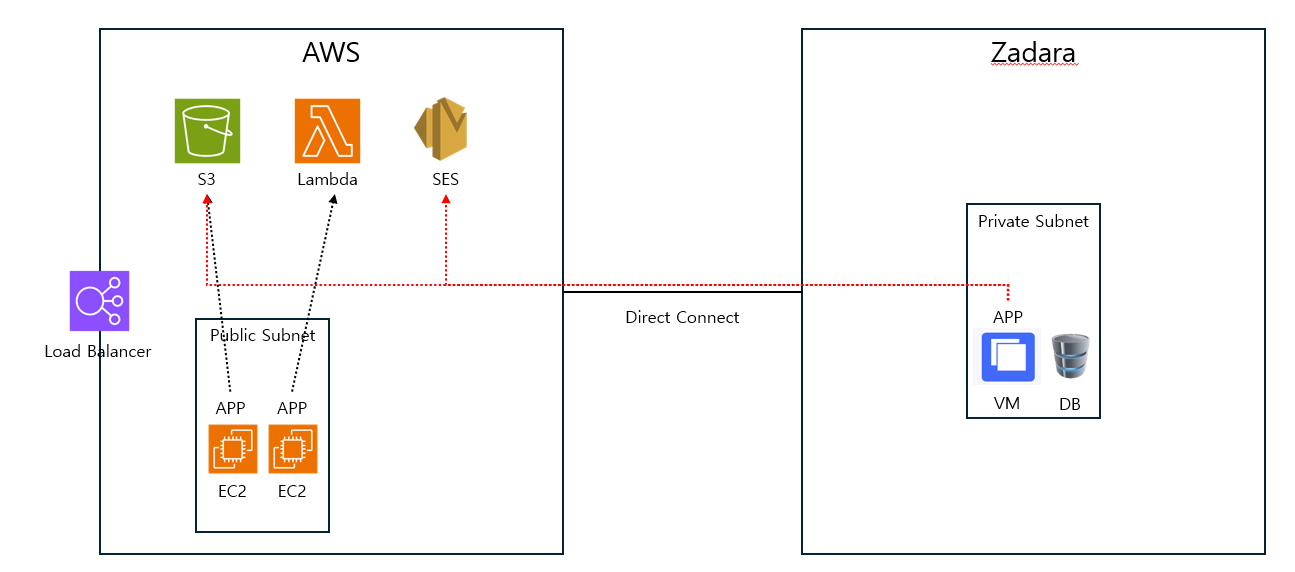
Example for AWS Console Setting (Trust anchors, Profiles, Roles)
Real-World Cloud Migration Strategy Success Stories
Xceptional Networks: Hollywood’s Critical Infrastructure
Xceptional Networks successfully migrated their customer Breakdown Services from AWS to Zadara, achieving better performance than AWS for critical MS-SQL servers. Breakdown Services provides essential casting services to major Hollywood studios, making performance and reliability crucial. The migration to Zadara’s zCompute platform not only improved performance but also allowed Xceptional Networks to increase margins while providing better service to their customers.
The success led to Breakdown Services becoming a large ZadarazCompute end-user, demonstrating the platform’s ability to scale for demanding enterprise workloads.
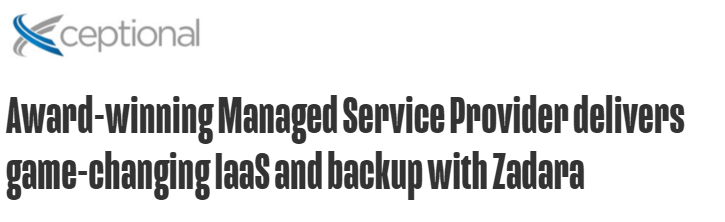
More details can be found at: https://www.zadara.com/customers/xceptional/
Private Sector in Brazil
A private company in Brazil responsible for administering public transport, user tickets and payments for public transportation migrated from AWS to Zadara on-prem cloud, including RDS, Fargate, Lambda, EC2 and S3. Millions of users daily use their payment method in transport. They also have a website and mobile app to recharge prepaid cards for bus, subway and trains.
Korean AI-driven Technology: 30-40% Cost Reduction
A Korean AI-driven technology startup faced increasing cost volatility with AWS usage and decided to migrate a portion of their workloads to Zadara. According to their internal calculations, which included data transfer fees and transaction costs, they achieved operational expense reductions of approximately 30-40%.
The migration allowed them to maintain their innovation pace while gaining cost predictability, a crucial factor for startups managing tight budgets and investor expectations.
A Leading Global Manufacturing Enterprise in Korea: Enterprise-Scale Migration
A leading global manufacturing enterprise (headquartered in Seoul, South Korea) faced growing hyperscaler costs and pursued a strategy of shifting core workloads to private cloud. Their existing VMware-based private cloud couldn’t deliver desired cost efficiency due to licensing costs and renewal risks.
After evaluating multiple options, they selected Zadara as an alternative, prioritizing operational continuity without requiring extensive retraining of operations teams.
The phased migration using RackWare is currently running based on a consumption-based pricing model and fully managed operations, delivering the cost efficiency and operational simplicity they needed. RackWare has been migrating different types of AWS VMs, including custom ones, such as: Amazon Linux 2 and Amazon Linux 2023 (AL2023).
NovaCloud
NovaCloud is South Africa-based ICT provider that depends on reliable, managed infrastructure to run its services. When a 23% rise in its AWS and Azure costs damaged customer satisfaction, NovaCloud partnered with Zadara to achieve a more predictable cost model.
The migration from AWS to Zadara was done with RakeWare.
Now the company leverages in-country Zadara Edge Cloud Services to deliver video streaming, Kubernetes-based microservices, and more for its customers.
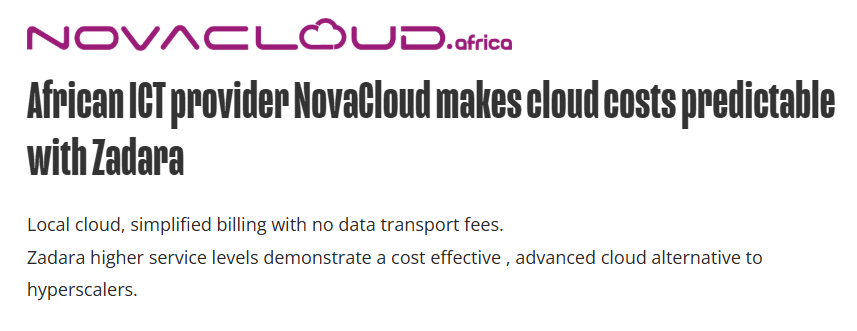
More details can be found at: https://www.zadara.com/customers/novacloud/
Nigerian Ministry of Education
An end-customer of Zadara partner in Nigeria did a migration of multiple VMs from AWS to zCompute for the Nigerian Ministry of Education.
Understanding AWS Sovereign Cloud vs. Zadara Alternatives
While AWS sovereign cloud options exist, many enterprises prefer Zadara’s private cloud control for several key reasons. Comparing AWS sovereign cloud to Zadara reveals significant advantages in sovereignty coverage, cost, and flexibility. The AWS sovereign cloud model differs from Zadara’s approach to data sovereignty, with Zadara offering more sovereign and granular control over data location and its access to monitor the cloud.
Zadara’s sovereign cloud approach provides the security and compliance benefits enterprises need while maintaining the operational simplicity of hyperscaler platforms. This combination addresses the core challenge many organizations face: achieving cloud benefits without sacrificing control or predictability.
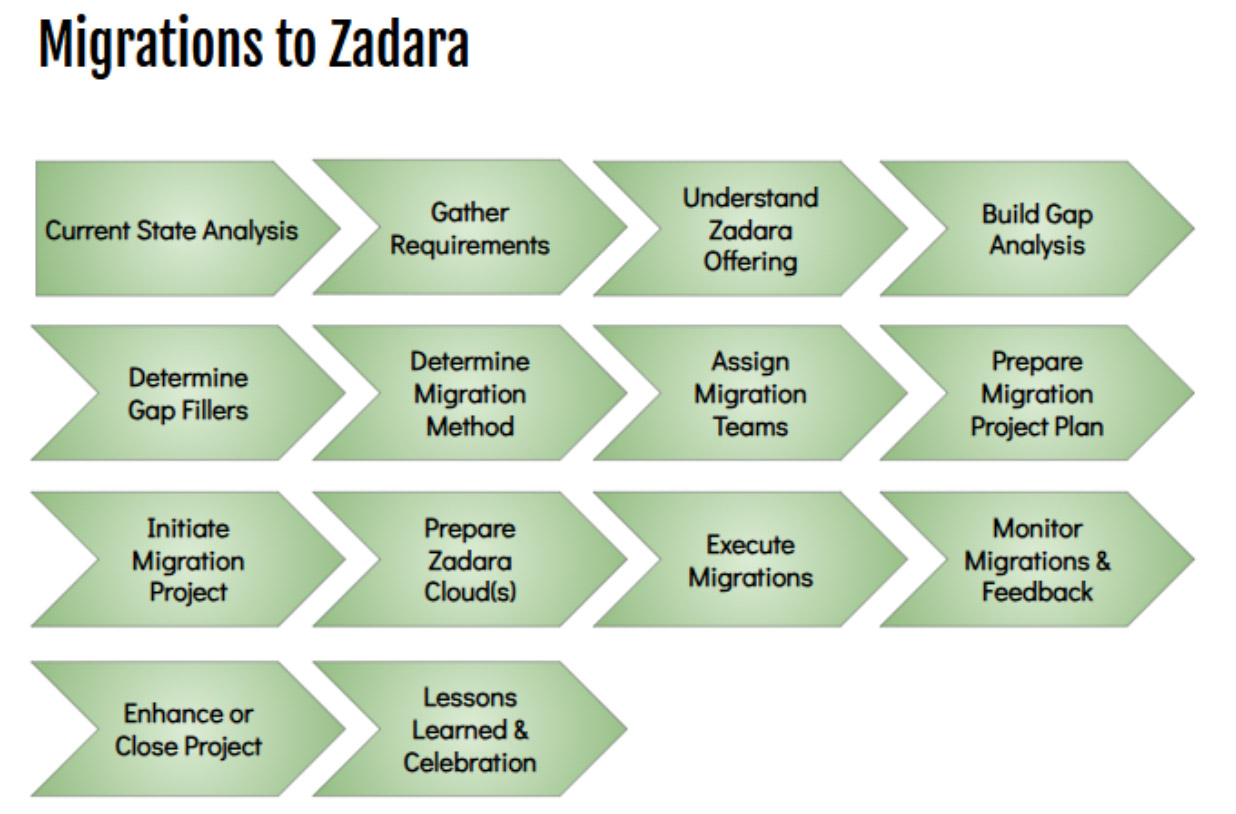
Planning Your AWS to Zadara Sovereign Cloud Migration Strategy
Success in any cloud migration strategy depends on thorough planning and realistic timeline expectations. Organisations should do a gap analysis and use the results to measure priorities, new solutions and timelines.
The cloud migration strategy should account for application interdependencies, data transfer requirements, and business continuity needs. Teams should also consider the learning curve for new platforms and plan appropriate training for operations staff. While Zadara’s intuitive interface reduces this learning curve significantly, proper preparation ensures smooth operations post-migration.
Consider starting with non-critical workloads to gain experience with the platform before migrating mission-critical applications. This approach allows teams to refine their processes and build confidence with Zadara’s tools and capabilities.
Next Steps: Begin Your Cloud Migration Strategy Journey
The AWS to Zadara Sovereign Cloud migration represents an opportunity to reduce costs, improve performance, and gain greater control over your cloud infrastructure while complying with sovereignty regulations. With 3 proven migration methods available, organizations can choose the approach that best fits their technical requirements, budget constraints, and timeline needs.
Whether you’re driven by cost concerns, performance requirements, or the need for greater data sovereignty, Zadara provides a compelling alternative to traditional hyperscaler platforms. The success stories from organizations like Xceptional Networks and NovaCloud demonstrate that migration to Zadara can deliver both immediate and long-term benefits.
Ready to explore how Zadara can transform your cloud infrastructure? Contact Zadara specialists to discuss your specific requirements and develop a customized migration strategy that minimizes risk while maximizing the benefits of your move away from AWS.