The problem every AI cloud operator eventually hits
The infrastructure gap every AI cloud operator eventually faces isn’t about the GPUs themselves. It’s about everything that has to happen between racking the hardware and actually delivering AI services to customers.
Picture a cloud provider that just won a significant deal. A bank, research institute, or telecommunications company needs substantial GPU capacity on its own terms.’
The NVIDIA GB200 and GB300 NVL72 rack-scale systems were ordered and are on their way. The NVIDIA Spectrum-X Ethernet networking is already being staged.
What’s missing is the orchestration layer that turns accelerated hardware into a cloud. A layer that ensures that the network fabric keeps thousands of GPUs communicating without bottlenecks and that the data platform and storage keep pace with training and inference at scale. The orchestration layer should also enable five, ten, or fifty tenants to possess their own secure slice of infrastructure without any tenant ever seeing another tenant’s data, models, or workloads.
This is the moment where most AI infrastructure projects get complicated.
Since in almost all cases compute comes from one vendor, orchestration from another, data platform, storage and networking from others still, the operator ends up integrating and re-integrating a stack that was never designed to work as one system.
For operators who must also meet digital sovereignty requirements, mandating that data, models, and operations stay fully within a defined boundary, under defined control, the stakes are even higher.
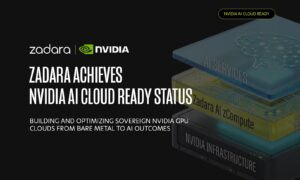
Zadara is now NVIDIA AI Cloud Ready
Zadara has achieved the recognition as an NVIDIA AI Cloud Ready validation partner from NVIDIA. Zadara’s platform officially meets the technical bar required to run production AI workloads on NVIDIA-accelerated infrastructure as part of the NVIDIA Cloud Partner (NCP) program. It’s a meaningful credential precisely because it validates the complete operating stack an AI cloud actually runs on.
For cloud service providers and enterprises deploying sovereign AI infrastructure and for organizations building AI factories, this validation
confirms that the hard work of integration – the tax paid assembling compute, network, storage, and GPU management into a functioning cloud has already been done by Zadara, and validated by NVIDIA.
What’s left for operators is turning capacity into revenue and AI outcomes.
What the validation actually covers
The NVIDIA AI Cloud Ready validation looks at the entire cloud solution and the whole picture: compute, networking, data platform, storage, and GPU working together as a validated system, not as five separate procurement decisions.
For Zadara, it means that the zCompute cloud orchestration platform is validated against NVIDIA’s reference architecture across the hardware that AI factory operators are leveraging today. Compute platforms: NVIDIA DGX and HGX servers, NVIDIA GB200 and GB300 NVL72 rack-scale systems, and NVIDIA Vera Rubin platforms. GPU generations: NVIDIA L40 and L40S GPUs for inference and mixed workloads, NVIDIA H100 and H200 GPUs for large-scale training and inference, and NVIDIA Blackwell and Blackwell Ultra GPU next-generation accelerators. Network fabrics: NVIDIA Spectrum-X Ethernet and InfiniBand networking.
In practice, Zadara-managed AI clouds today run anywhere from 16 to thousands of GPUs on a single deployment, on the same validated stack, whether that stack sits on an NVIDIA servers or rack-scale systems.
That’s the credibility part. The more interesting part is what it means for how quickly an operator can actually get from hardware rack and stack to a running AI workload.
From Bare Metal to AI Outcome: A Day 0, Day 1 & Day 2 Story
Go back to that cloud provider from the opening paragraph. Here’s what the same story looks like running on Zadara.
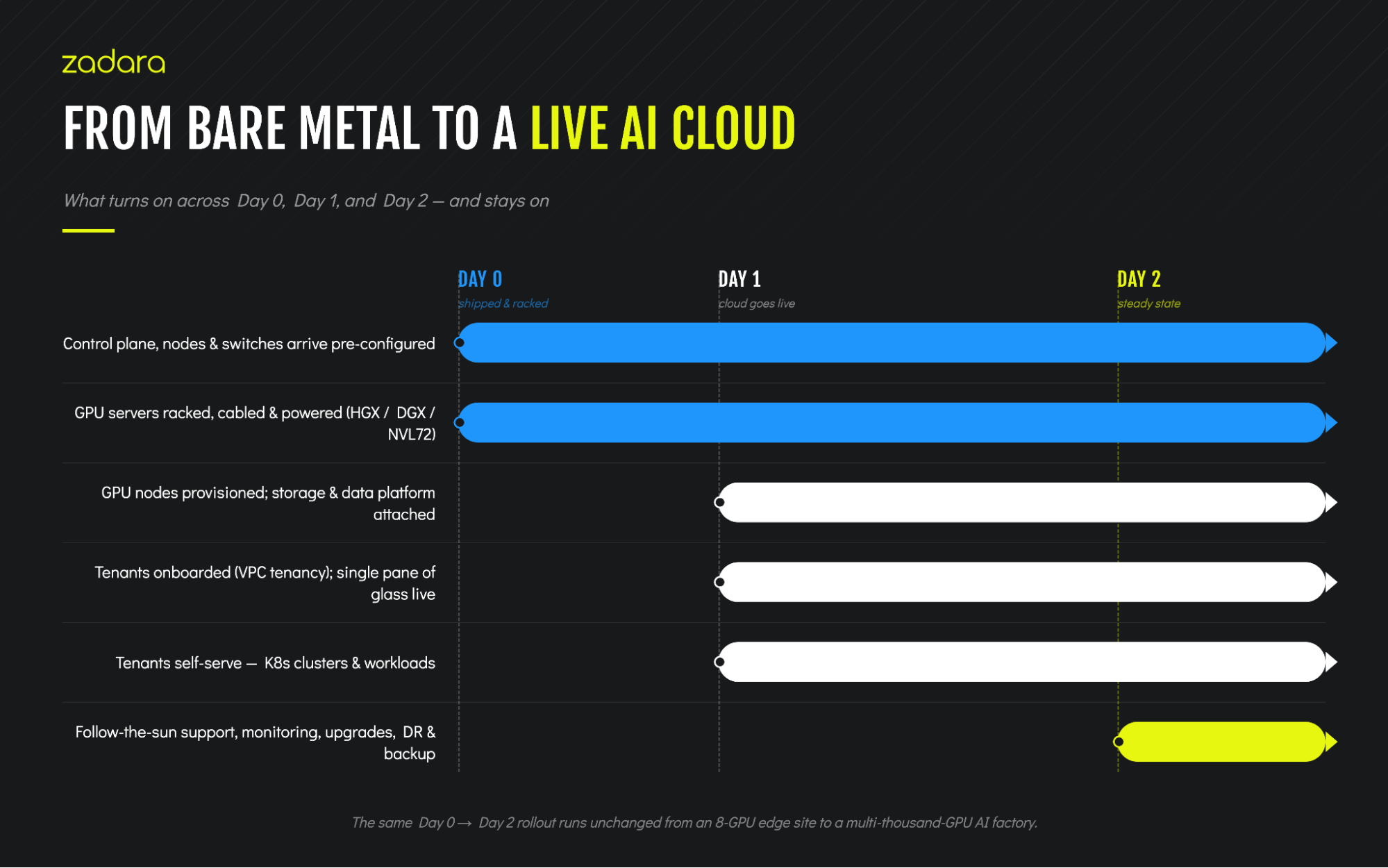
On Day 0, the zCompute control plane nodes and switches arrive pre-configured. GPU servers, HGX, DGX or racks, are racked, cabled, and powered on site while the control plane comes up alongside them.
On Day 1, the cloud comes to life. The zCompute control plane provisions the GPU nodes, hypervisors installed server by server, storage and data platform attach, and tenants and AI practitioners are onboarded with their own VPC-style tenancy. Compute instances spin up. A single pane of glass is live for management and control, and tenants are already self-serving, provisioning their own Kubernetes clusters and instantiating their own workloads without waiting on the operator’s operations team.
Day 2 is where the operational payoff compounds: follow-the-sun support, continuous monitoring, non-disruptive upgrades, and built-in disaster recovery and backup empower the cloud that went live on Day 1 to keep running without the operator having to re-earn its uptime every quarter.
The point of walking through it this way is simple: it demonstrates that the hard part of standing up an AI cloud, including the integration tax between compute, network, data platform, storage, and GPU, tenants and users management, has already been paid, once, by Zadara and validated by NVIDIA.
What’s left for the operator is turning capacity into revenue, driving home faster ROI.
The Same Stack, from Edge to AI Factory
That story remains consistent regardless of the size of the deployment. A telco lighting up an edge AI site with 8 to 32 GPUs close to its customers runs the same zCompute stack as a cloud provider running hundreds or thousands of GPUs for enterprise and MSP tenants, or a research institution running an on-prem HPC AI cluster.
NVIDIA’s rack scale systems give that growth path a physical form, the same building block scales from a single rack to a full AI factory. Zadara’s software gives it an operational one. Operators can start with a compact AI cloud and grow into a hyperscale one without a rip-and-replace.
This consistency matters economically. Operators don’t need to maintain separate operational expertise, different management tools, or distinct infrastructure-as-code repositories for edge versus data center deployments. The same orchestration model, the same security controls, the same multi-tenancy isolation, and the same automation scale across the entire GPU infrastructure footprint.
Why the architecture matters more than the checklist
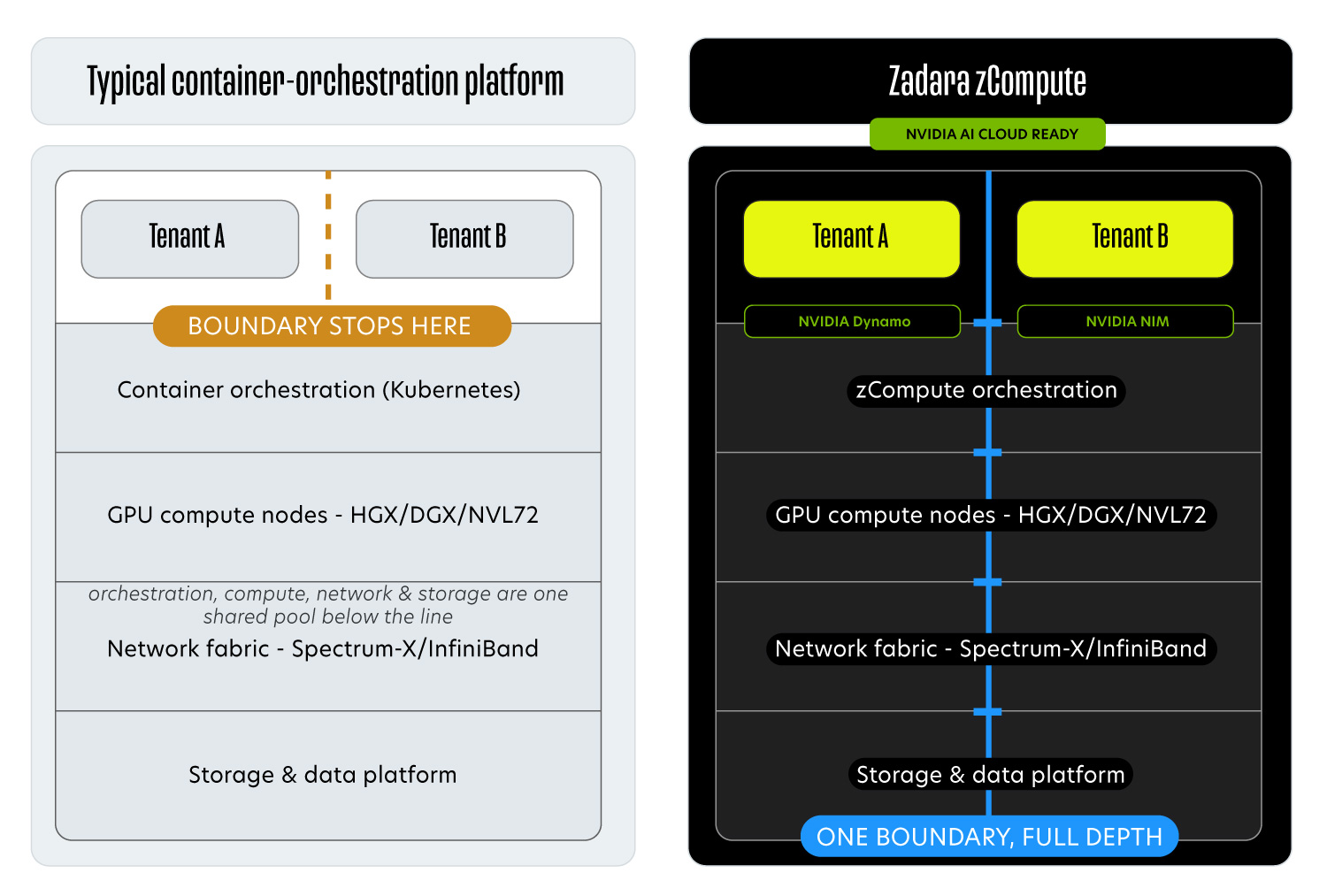
Many platforms in the GPU cloud management space are built around container orchestration layers, which is a reasonable approach for getting GPUs into production quickly. This works well right up until an operator needs real isolation between tenants. Container orchestration does not provide real isolation between tenants.
Zadara takes a fundamentally different approach. Zadara multi-tenancy is enforced across compute, network, data platform, and storage, not just at the orchestration layer. Isolation between tenants becomes a property of the infrastructure itself rather than a policy configured on top of shared resources.
This infrastructure can also be operated via EC2 API, or as an Infrastructure as a code architecture. Workloads already running on AWS cloud infrastructure can migrate onto Zadara-managed GPU Cloud infrastructure without being rewritten. Teams can leverage existing Terraform modules, automation scripts, and operational expertise immediately.
The practical result: one platform running AI training, inference, RAG applications, and agentic workloads side by side with general-purpose compute and disaster-recovery services, all under the same single pane of glass management. Operators don’t license and stitch together different tools for each infrastructure layer.
Digital Sovereignty, Security, and AI Control
For a growing number of operators, the question isn’t just “can I run this AI workload” but “can I guarantee where the data, the model, and the pipeline that touches them actually live, and who can reach them.”
That’s what AI digital sovereignty means in practice: full operational autonomy inside defined boundaries, with no cross-tenant interference and no ambiguity about where control ends and another tenant’s environment begins.
Organizations deploying NVIDIA infrastructure within their own boundaries, whether for regulatory compliance, data residency mandates, or strategic autonomy, need more than accelerated hardware. They need sovereign AI infrastructure that guarantees:
Data Locality and Residency
Training datasets, inference results, model weights, and operational telemetry never leave defined geographic or jurisdictional boundaries. For financial services processing transactions in the EU, healthcare organizations managing patient data under HIPAA, or government agencies with national security requirements, this isn’t a nice-to-have feature, it’s a legal requirement.
Operational Control
Full autonomy over who accesses infrastructure, when upgrades happen, how resources are allocated,which workloads run and where. Public cloud providers may offer regions within countries, but ultimate control still resides with the hyperscaler. Zadara’s model puts control with the infrastructure owner.
Regulatory Compliance from Day One
Architecture designed to support GDPR, HIPAA, SOC 2 Type 2, ISO 27001, and regional data sovereignty mandates without requiring custom compliance implementations per jurisdiction. Zadara’s isolation model is built for exactly these guarantees, backed by end-to-end encryption in transit and at rest, RBAC and IAM controls, VPC-level security groups, and compliance frameworks proven across 500+ sovereign cloud locations Zadara operates globally.
This is where NVIDIA AI Cloud Ready validated solutions like Zadara differentiate from public cloud alternatives: complete sovereign control without sacrificing operational simplicity or the cloud experience developers expect.
Where this goes next
The NVIDIA AI Cloud Ready validation is a recognition of the stack that’s already running.
What it enables is the part that matters to operators: the ability to go from bare metal to a secure, multi-tenant AI outcome without assembling it themselves, at whatever scale, edge, enterprise, or AI factory their business actually needs.
If you’re evaluating how to bring GPU capacity to market as a secure, multi-tenant AI cloud, we’d like to talk.