Deploying GPUs is not deploying a cloud. Utilization is not monetization.
Enterprises have spent the past few years buying GPUs as fast as vendors could ship them according to IDC Report. Now many are learning that the accelerators were the easy part. At banks, hospitals, manufacturers, and universities, IT teams are finding that a rack of GPUs is only one piece of enterprise AI infrastructure, and on its own it doesn’t deliver results according to Gartner.
Look behind any AI system running in production and you’ll find a tangle of technology that all has to work together. Servers and GPUs need to work alongside compute, data platforms, networking, Kubernetes, security, telemetry and management systems. Each layer needs to be deployed, integrated, secured and operated reliably.
Companies that try to build all of this themselves often find their AI initiative has turned into a multi-vendor integration exercise.
Zadara, an NVIDIA partner and full-stack provider of sovereign cloud infrastructure, networking, and storage, has now joined the Lenovo AI Innovators program.
Together, Zadara and Lenovo address the most prominent enterprise AI challenges.The challen to crack is turning GPU infrastructure into a fully operational, multi-tenant cloud.
It is nonetheless challenging to maximize value-generating capacity while maintaining isolation, stability, performance, and flexibility.
Zadara’s participation in the Lenovo’s partnership program is designed to address these challenges by pairing Lenovo’s servers with Zadara’s cloud platform. The result is a managed, secure, integrated environment that is ready to run AI applications in production, providing the teams who build them an automated, secure and scalable platform to build upon.
The goal is simple: make it easier for enterprises to move from AI hardware to an operational AI cloud.
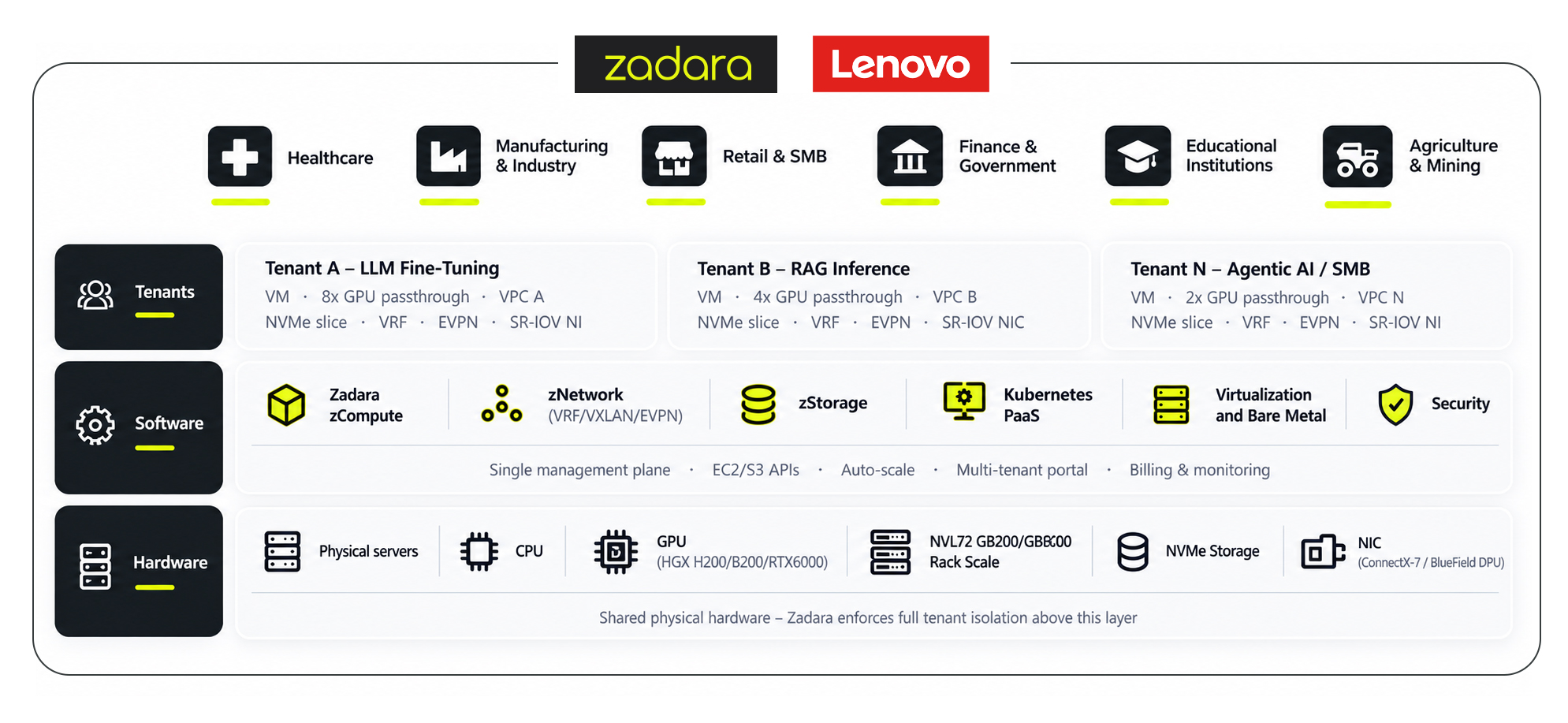
Fig. 1 – Zadara and Lenovo deliver integrated Enterprise AI solutions
AI Infrastructure Is More Than GPUs
GPUs get the headlines when companies plan for AI. But a powerful accelerator, on its own, is not a production AI environment.
Enterprise and ESMB AI infrastructure is the full stack required to run AI workloads in production: GPU servers and compute, storage, networking, Kubernetes and container orchestration, security and workload isolation, and the monitoring and management tools that operate it all as one environment.
Organizations also need to answer fundamental infrastructure questions.
How will compute resources be provisioned? How will workloads access storage? How will networking be configured? How will Kubernetes environments be deployed and managed? How will resources be isolated between teams or workloads? How will the infrastructure be monitored, secured and scaled?
Solving each requirement independently may require multiple vendors, each with its own management tools, operational processes and support relationships.
That creates a fundamental challenge for enterprise AI:
The more time infrastructure teams spend integrating and operating the underlying environment, the less time the organization can spend focusing on the AI applications and outcomes the infrastructure was purchased to support.

Send us a Message
We’d love to hear from you—please reach out with any questions, feedback, or collaboration ideas.
Lenovo Provides the AI Infrastructure, Zadara Provides the Orchestration Layer
The Zadara and Lenovo relationship brings together two complementary parts of the AI infrastructure stack.
Lenovo provides the enterprise server and GPU infrastructure.
Zadara provides the orchestration and operating layer used to orchestrate and manage compute, GPUs, storage, networking and Kubernetes.
Rather than treating these infrastructure components as separate environments, Zadara brings them together through a unified management platform.
This gives organizations an integrated foundation for building private and sovereign AI environments while maintaining the cloud-like operational capabilities enterprise teams have come to expect.
One Platform Across the AI Infrastructure Stack
A major objective of the joint approach is reducing the number of individual infrastructure platforms customers need to manage.
Zadara provides capabilities across:
- Virtualized and bare-metal compute
- GPU orchestration
- Cloud block, file storage and object storage
- Cloud networking
- Kubernetes-as-a-Service
- Strong multi-tenancy and workload isolation
- EC2 API compatibility
- Autoscaling
- Telemetry
- Centralized infrastructure management
Instead of separately assembling compute, storage, networking and orchestration platforms, enterprises can manage these infrastructure resources through a common operational layer.
For IT and infrastructure teams, this means fewer moving parts and a more consistent approach to operating the environment.
Start Small Without Starting Over: Scaling GPU Infrastructure
Not every enterprise needs to begin its AI journey with a massive GPU deployment.
Many organizations need the flexibility to begin with a relatively small number of servers or GPU clusters, prove the value of their AI initiatives and expand infrastructure as demand grows.
That creates another important consideration: Will today’s infrastructure model still work when the environment becomes significantly larger?
Zadara and Lenovo are designed to provide a consistent operational model across different deployment scales.
An organization can begin with a smaller AI environment and expand its compute, GPU, storage and networking resources while continuing to use the same underlying management stack.
That allows infrastructure to grow alongside AI demand without requiring organizations to fundamentally rethink how the environment is operated each time it expands.
Bringing Orchestration to Private and Sovereign AI
Public cloud has established expectations around how quickly infrastructure should be provisioned and consumed.
Enterprises building private AI infrastructure increasingly want those same operational characteristics while maintaining greater control over where their infrastructure and data reside.
Zadara brings cloud capabilities to Lenovo infrastructure, including EC2 API compatibility, autoscaling, integrated software-defined cloud storage and networking, and managed Kubernetes services.
The result is a cloud-like orchestration infrastructure experience deployed on enterprise infrastructure.
For organizations with sovereignty requirements, this model also provides a path to operating infrastructure and Kubernetes environments within a controlled sovereign cloud architecture.
How Secure Multi-Tenancy Raises GPU Utilization and Shortens Time to Value
GPUs are expensive, and an idle GPU is money burning. Industry studies put average enterprise GPU utilization at just 5% according to cast.ai report.
The usual cause is simple: each department or project gets its own dedicated servers, and those servers sit unused between jobs.
Zadara’s answer is hardware-assisted multi-tenancy. In plain terms, many teams share the same pool of Lenovo GPU servers, but each team works inside its own walled-off tenant. Those walls are enforced at the hardware level, not just by software settings that a single misconfiguration could undo. Each tenant is assigned its own VPC at the networking level, and GPUs are passed-through to VMs at the node level. One team can’t see another team’s data, and one team’s heavy training job doesn’t slow anyone else down. “Managing vpc and gpu association
This becomes particularly valuable as enterprise AI adoption expands beyond an initial project.
Finance, R&D, and customer service can each run their own models, and even their own Kubernetes clusters, on the same hardware, while one platform team manages everything underneath.
For companies building shared AI infrastructure, that turns a collection of GPUs into a flexible internal cloud.
At the basic level, each and every workload must utilize its resources in full within its tenancy boundaries. On top of it, the orchestration layer must optimize and automate tenants allocations, bring up and tear down, keeping strong demarcation lines between tenants of varying sizes, shapes and scales, ensuring secure and fluent operation for each workload.
This is how utilization eventually shortens time to value and increases ROI.
Simplifying AI Infrastructure: Plan, Deploy, Operate (PDO)
The complexity of AI infrastructure goes far beyond the hardware. Organizations need to bring together compute, GPUs, storage, networking and cloud software, then operate that environment reliably at scale.
| Phase | Building It Yourself | Zadara + Lenovo |
|---|---|---|
| Day 0: Plan and Buy | Separate vendors for servers, GPUs, storage, networking, and software, each with its own contract and support line. | One integrated, pre-tested hardware and software stack from a single partnership. |
| Day 1: Deploy | Weeks or months of cabling, configuration, and integration testing. | Pre-integrated deployment, configurable in minutes instead of days. |
| Day 2: Operate | In-house teams patch, monitor, and troubleshoot across multiple consoles and vendors. | Managed service with one control plane and follow-the-sun support. |
What’s Next for Enterprise AI Infrastructure
The next chapter of enterprise AI won’t be decided by who buys the most GPUs.
It will be decided by who runs them well: how those GPUs are operated, shared, secured, and scaled.
That’s the opportunity behind the Zadara and Lenovo relationship.
Lenovo provides the enterprise infrastructure foundation. Zadara provides the orchestration operating layer that brings compute, GPUs, storage, networking and Kubernetes together.
Zadara is also an NVIDIA AI partner and operates more than 500 general-purpose and storage cloud locations worldwide, bringing experience operating distributed enterprise cloud infrastructure to the partnership.
Together, Zadara and Lenovo give enterprises a way to stop simply deploying AI hardware and start running a secure, scalable private AI cloud.
Schedule a Consultation
Get a personalized demo and learn how Zadara can transform your infrastructure strategy with our experts.
Frequently Asked Questions About Enterprise AI Infrastructure
What is a private AI cloud?
A private AI cloud delivers public cloud capabilities such as self-service provisioning, APIs, autoscaling and managed Kubernetes on dedicated infrastructure the organization controls. With Zadara and Lenovo, Lenovo supplies the server and GPU infrastructure and Zadara supplies the cloud operating layer that turns it into a private or sovereign AI cloud.
What is the difference between AI infrastructure and an AI cloud?
AI infrastructure is the underlying hardware and software: GPUs, compute, storage and networking. An AI cloud adds the operating layer that lets teams provision, share, isolate, monitor and scale those resources on demand, the same way they would consume public cloud services.
How does multi-tenancy improve GPU utilization? How does it bring value?
Instead of dedicating GPU servers to a single team or workload, multi-tenancy allows multiple teams and workloads to share a common pool of resources in isolated environments, so less capacity sits idle. Zadara uses hardware-assisted multi-tenancy to keep workloads separated while the platform remains centrally managed.
Each workload gets the resources it needs, even when workloads need very different things, and some may need their own Kubernetes clusters. The platform scales up and down automatically and reclaims capacity when jobs finish, so less sits idle and the cost per workload drops
This is how utilization yields value.
Can enterprises start small with AI infrastructure and scale later?
Yes. Organizations can begin with a small number of servers or GPU clusters and expand compute, GPU, storage and networking resources over time while continuing to use the same Zadara management stack.
How does the integrated AI infrastructure approach work?
Lenovo and Zadara bring hardware and cloud software together as an integrated solution, simplifying deployment and reducing the effort required to connect individual infrastructure components. Once operational, Zadara provides centralized management, monitoring, scaling, updates and support as a managed service backed by follow-the-sun support.