Zadara runs High-Performance Computing (HPC) as a managed, multi-tenant cloud inside a facility the owner chooses, from a few nodes next to an instrument to a regional cloud. The hardware belongs to the owner and stays in its jurisdiction, and Zadara runs the cloud around the clock.
This work grew out of two conversations that kept coming back this year. Research institutions, national programs and regulated industries told us their data, and more and more their models, have to stay inside a border or a building, and their HPC has to move there with it. Teams that run HPC clusters told us about a different problem, expensive hardware dedicated to one project and idle whenever that project is. A sovereign cloud addresses both, because it can sit wherever the data has to stay and many tenants can share its nodes safely.
HPC is moving to where the data has to stay
Large national and university supercomputers remain the right place for capability runs that need a whole machine, and nothing here replaces them. A growing share of HPC work looks different. Think of genomics pipelines at a hospital, simulation for a manufacturer that can’t send design data abroad, environmental models run by a national agency, or fine-tuning a model on data that is regulated where it was collected. These jobs need tens or hundreds of nodes rather than thousands, and they need them close to the data, under local law and local control.
Sovereign regions in public clouds go part of the way. The data stays in the country, while operating control stays with the provider. For a growing number of buyers, who holds that control is now the first question they ask, and the answer they want is an environment they own, in a facility they choose, where they decide who has access and when anything changes.
That’s what we mean by a sovereign cloud. It runs where the owner chooses, at the size the owner needs. The same Zadara services run in a 4U cabinet next to an instrument, in a single rack at a research site or across dozens of racks in a regional data center, and every site is used through the same portal and APIs.
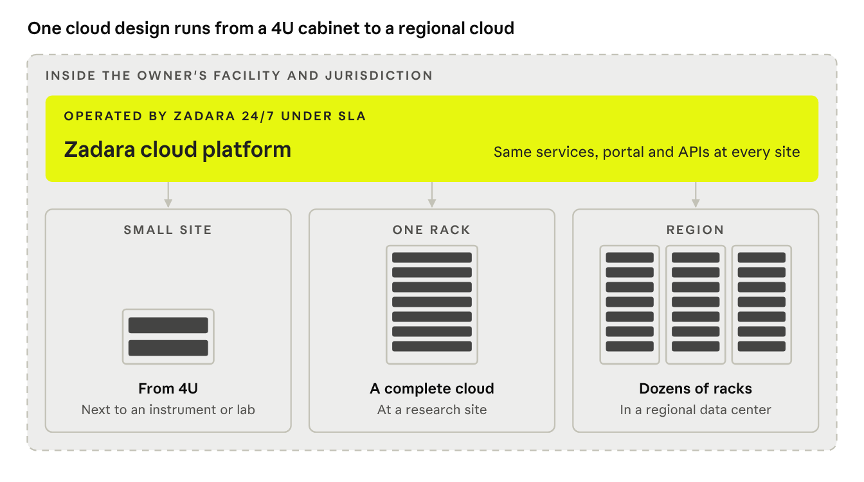
one cloud design · edge site, single rack, regional cloud
Every site runs the same platform and services, and the hardware and data stay inside the owner’s facility and jurisdiction.
Scale changes the hardware, not the cloud. A 4U cabinet and a multi-rack region run the same software, services, APIs and operations, and a tenant can’t tell which one it’s using. What changes with size is the number of nodes, and the redundancy the platform keeps so it stays up through failures and upgrades.
Running HPC as a cloud
Much of today’s HPC capacity is dedicated, with a cluster per project or a set of nodes per customer. Bare-metal rental is a reasonable model, and for a user who keeps a node busy around the clock it’s the right one. Most users don’t. A dual-socket Intel Xeon 6900 series node has up to 256 performance cores, and when the project that owns it pauses, those cores sit idle while other users wait in a queue or take their work elsewhere.
On the Zadara platform the same nodes become a cloud that many tenants share. A tenant is an organization that uses the cloud, such as a research group, a department or a paying customer. Tenants don’t own hardware. The owner decides how much capacity each one gets, and can dedicate nodes to a tenant that needs them. Otherwise tenants share the physical nodes, but each one gets its own VPC, storage, users, roles and quotas, and sees only its own instances, networks and data. Splitting work across tenants adds no load of its own. Ten tenants running one VM each load a node the same way one tenant running ten VMs does, and owners manage how much work lands on each node with instance types and quotas, as they would on any cloud.
Tenants choose how they schedule their work, and HPC teams that want Slurm have two ways to run it. The first is Slurm directly on Zadara instances inside the tenant’s own VPC. Slurm was designed to share a cluster among users who trust each other, and it doesn’t separate organizations the way a cloud does. A Slurm cluster per tenant gives every group the scheduler it already knows, with the cloud’s isolation, quotas and metering underneath. The second is Slinky, SchedMD’s open-source project for running Slurm on Kubernetes, deployed on Zadara managed Kubernetes. Slinky runs Slurm’s daemons as pods and can also let Slurm schedule Kubernetes workloads, so batch jobs, containers, inference servers and agent frameworks share one cluster without the tenant operating Kubernetes itself.
Every kind of node shows up as instance types in one catalog. An HPC instance on a liquid-cooled node is launched the same way as a web server or a GPU instance, and they can share a VPC, storage and a usage report. Metering treats an hour on an HPC node, a GPU or a storage volume the same way, so an owner can charge back internal groups or bill external customers from one record. Put together, that lets an organization be the cloud for its own teams or its customers, instead of renting capacity from one.
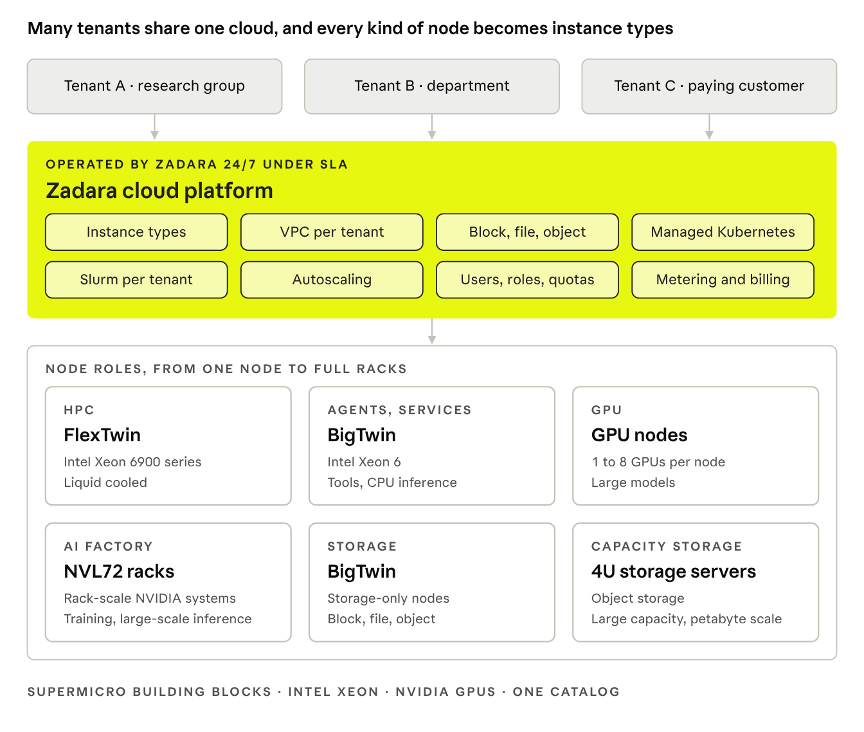
tenants, platform and node roles
Tenants share the nodes through the platform, each with its own VPC, quotas and metering, and every node role shows up in one instance catalog.
Agentic AI runs on the same cloud
HPC sites are also where many organizations now run AI, and agentic AI changes what that hardware is asked to do. An agent working through a task plans its steps, pulls documents from a search index, queries a database, calls a tool or two and runs a short script it wrote, then asks a large model to reason over what it found. Only the model calls need a GPU. Orchestration, retrieval and the sandboxes that generated code runs in are CPU work, and that work grows with the number of agents and the steps each one takes, whatever the size of the model.
Many of the models in an agent pipeline are small, too. Embedding, reranking, classification and guardrail models (and, more and more, small language models) run well on CPUs. Intel Xeon 6 processors with performance cores include Intel Advanced Matrix Extensions (Intel AMX), matrix acceleration built into each core for low-precision formats such as INT8 and BF16, so those models can run on the same Xeon nodes as the agents that call them.
The right ratio of CPU to GPU capacity is hard to predict, and it changes every time agents gain tools, steps or users. In one cloud it comes down to instance counts, autoscaling groups and Kubernetes node pools, with each side scaling on its own, which keeps the GPUs busy with GPU work. For the GPU side, Zadara is an NVIDIA AI Cloud Ready validated partner. The validation tests AI cloud software end to end, across networking, compute, orchestration and the AI platform layer, so GPU instances and managed Kubernetes start from a stack NVIDIA has tested for production AI clouds.
The same stack scales up to AI factory deployments. Rack-scale NVIDIA NVL72 systems join the cloud as another node role, next to the HPC, agent and storage nodes, under the same tenancy, catalog and metering. An owner can start with a few GPU nodes for agent workloads and add NVL72 racks when training and large-scale inference outgrow them, without moving to a different platform.
From a 4U cabinet to a region
Zadara runs on industry-standard x86 servers, with each node dedicated to one role: general compute, storage, GPU, and for HPC, dense nodes such as Supermicro FlexTwin with Intel Xeon 6900 series processors and up to 128 performance cores per socket, often liquid cooled. The same cloud also takes rack-scale NVIDIA NVL72 systems for AI factory deployments, and 4U high-capacity storage servers for petabyte-scale object storage. We validate configurations on current server platforms, including Supermicro BigTwin systems for general compute and storage, and as new generations ship, new nodes join the same cloud next to the ones already there.
Our current test cloud shows what that looks like at small scale. It mixes BigTwin compute nodes running Intel Xeon 6 processors, a FlexTwin node with two Intel Xeon 6972P processors and 192 cores between them, and two Supermicro storage nodes. The platform keeps a hardware inventory for every node, from motherboard and CPUs to memory, drives and network adapters, so the FlexTwin node shows up next to the BigTwin nodes with its role and model, and it already runs VMs and volumes like any other compute node. It’s a lab system for now.
A small site can start in 4U and add HPC and GPU nodes as demand shows up, and a large one grows to dozens of racks without changing the architecture. One practical note: a VM on a lone HPC node has nowhere to live-migrate during maintenance, so plan on at least two nodes of each type you want to keep running through upgrades. Everything above the hardware, from instances to tenants to metering, is handled by the Zadara platform.
Operated by Zadara, controlled by the owner
Most of the work in running a cloud, and most of the cost, comes after it’s installed. Zadara has run this platform in production for more than a decade, across more than 500 cloud locations, and operates each cloud for its whole life from operations centers in five regions. That covers monitoring and incident response under SLA, patching and security updates across the stack, platform upgrades scheduled with the owner, and capacity planning so new nodes arrive before tenants run short. A new site goes from delivered racks to running tenants in days rather than months.
Zadara operating the cloud doesn’t move control away from the owner. The hardware belongs to the owner, in a facility the owner picks. Data, models, results and telemetry stay within the geographic and jurisdictional boundaries the owner defines, and the owner decides who can access the infrastructure, when upgrades happen and where workloads run. Alerts can go to the owner’s own team as well as to Zadara. The platform supports GDPR, HIPAA, SOC 2 Type 2 and ISO 27001 controls, with encryption, role-based access control and VPC-level security groups.
Where to find us
We are at Supercomputing this week. If you’d like to meet there, or talk about a site you’re planning, whether it’s a single cabinet or a regional cloud, get in touch.